Ball Python Care
The Complete Guide to Healthy Ball Python Husbandry and Care

The Complete Guide to Healthy Ball Python Husbandry and Care
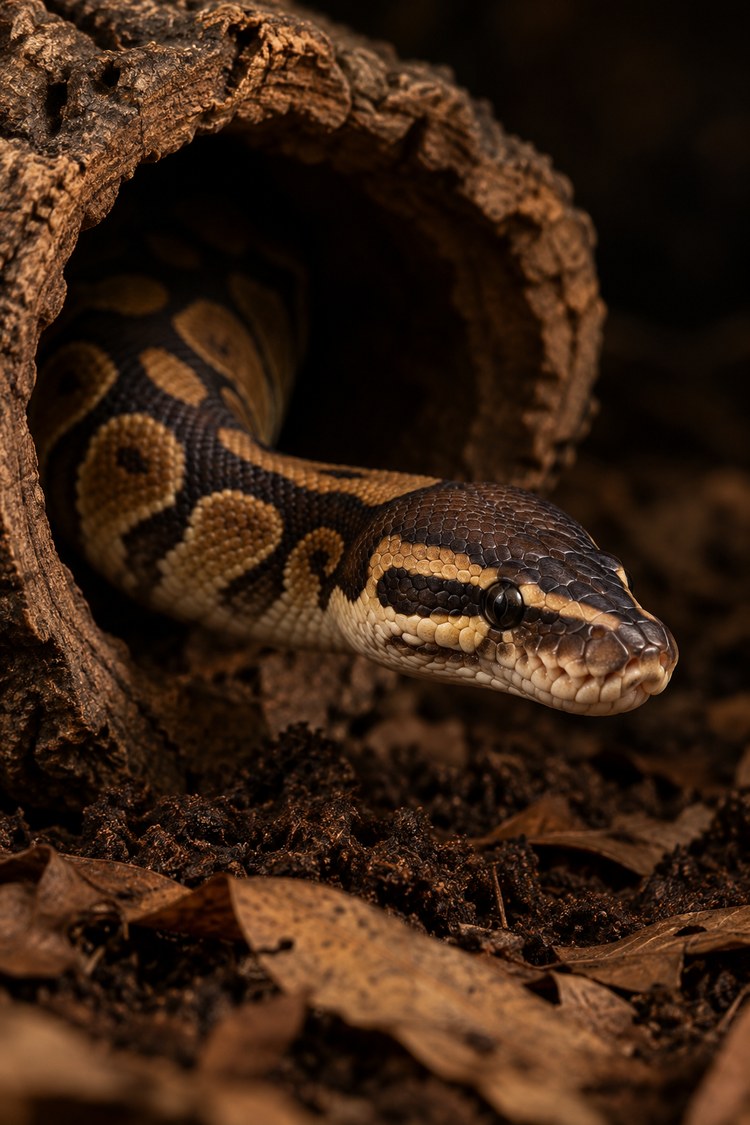
Ball pythons have a reputation for being easy snakes. That description is only partly true.
A healthy ball python does not need constant attention. Still, good ball python care depends on the right temperature gradient, humidity, hiding places, enclosure size, diet and lighting. The snake also needs real opportunities to behave naturally.
The ball python, Python regius, is also known as the royal python. It is native to western and central Africa, from Senegal east to Sudan and Uganda. There it lives in grasslands, savannas, open woodland and farmland, often sheltering in burrows and termite mounds.
Ball pythons are often described as strictly terrestrial. In reality, however, they also climb, and males in particular show semi-arboreal behavior.
In captivity, ball pythons commonly live 20–30 years with good care. The oldest known individual lived to 62 at a zoo. As a result, ball python care is a long-term commitment.
| Care factor | Recommended approach |
|---|---|
| Adult enclosure | At least long enough for the snake to stretch out fully; about 4 × 2 × 2 ft is a practical baseline for many adults |
| Warm area | About 86–90°F (30–32°C) |
| Cool area | About 75–80°F (24–27°C) |
| Night temperature | Roughly 70–78°F (21–26°C) |
| Humidity | Generally around 60–80%, with good ventilation |
| Lighting | A consistent day/night cycle |
| UVB | Low-level UVB is beneficial when correctly provided |
| Diet | Appropriately sized whole prey |
| Water | Clean drinking water available at all times |
| Housing | One ball python per enclosure |
| Activity | Mainly active at dusk and at night |
| Lifespan | Commonly 20–30 years with proper care |
These numbers are starting points. Good ball python care provides gradients and choices, not one identical environment everywhere.
Habitat
A ball python enclosure should let the snake move, stretch, hide, climb, thermoregulate, drink, explore and change position comfortably.
For many adults, an enclosure of about 4 × 2 × 2 feet is a practical minimum starting point. However, there is a better rule: the enclosure should be at least long enough for the snake to stretch out fully. So, if your ball python grows longer than four feet, provide more length.
Large enclosures do not stress ball pythons by themselves. On the other hand, large, exposed and poorly furnished enclosures can. A young snake can live well in a spacious enclosure when it contains enough hides, foliage, branches, visual barriers and other secure areas.
Welfare research supports giving ball pythons enough space and complexity to express normal behavior. In furnished terrariums, ball pythons have been recorded climbing, basking, burrowing, bathing and exploring. In contrast, snakes kept in restrictive rack systems could not show these behaviors.
Simply put, the goal is not more empty floor space. The goal is to give that space a function.
Ball pythons spend a lot of time sheltering in enclosed spaces. Provide at least:
The warm and cool hides should be equally secure. Then the snake never has to choose between its preferred temperature and its preferred hiding place.
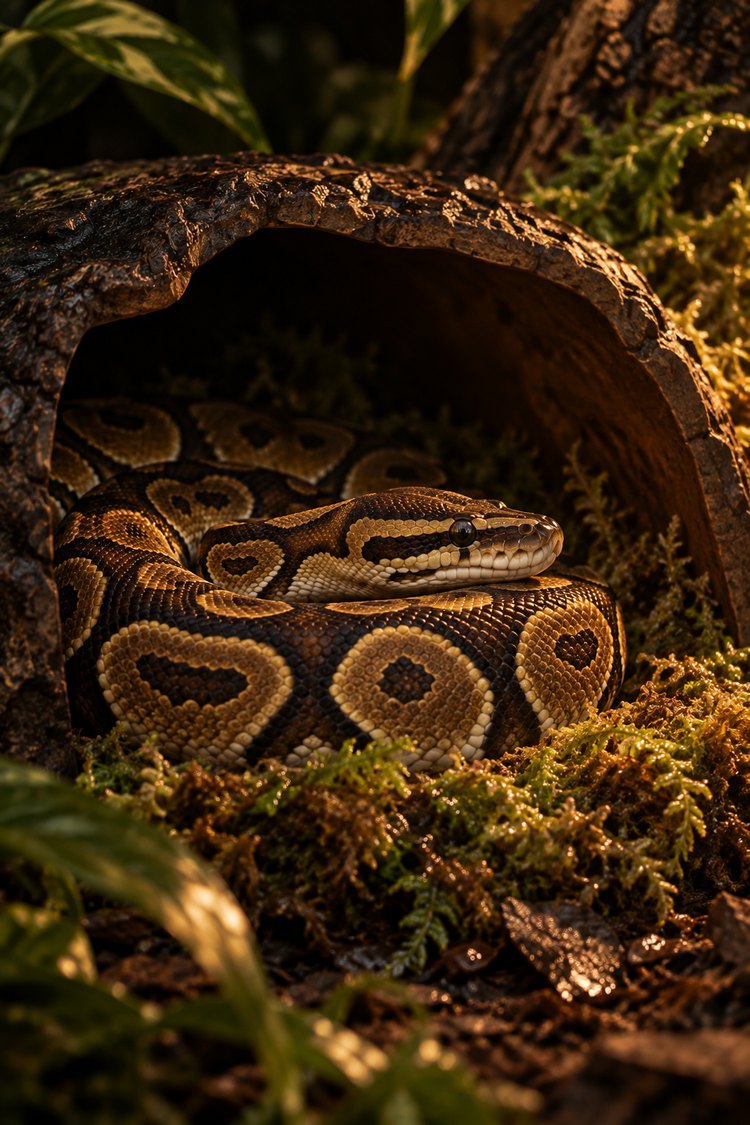
Furthermore, a good hide should feel snug when the snake is coiled inside. It should not squeeze the snake, but it should not resemble a large open cave either. In addition, extra cork, foliage, leaf litter, tunnels and partly covered areas make the enclosure feel more secure.
One persistent myth says ball pythons are too terrestrial or clumsy to benefit from climbing.
They climb.
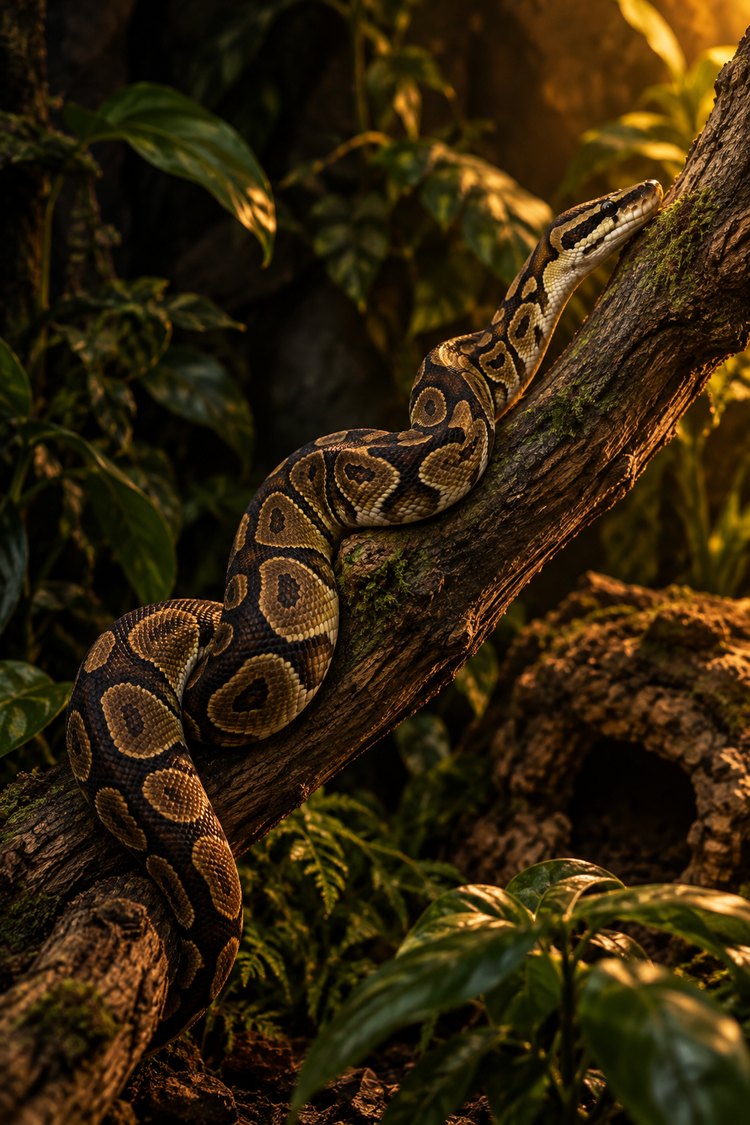
Field observations and captive studies both support climbing behavior in Python regius. Males seem especially likely to use elevated areas, but climbing is not limited to males.
Provide sturdy branches, cork structures, shelves or raised platforms that can safely support the snake’s weight. At the same time, avoid unstable décor that could collapse.
Height does not replace floor space. Still, usable vertical structure adds valuable exercise and behavioral choice to ball python care.
Heat & Light
Like all reptiles, ball pythons are ectothermic. They depend on environmental heat to regulate their body temperature. The enclosure should therefore contain a thermal gradient.
A useful target is:
However, do not heat the entire enclosure to the warm-side temperature. The snake must be able to move between warmer and cooler areas.
Veterinary guidance lists a preferred temperature range of roughly 77–86°F (25–30°C) for ball pythons, with a warmer local spot for basking. Welfare-focused husbandry guides usually set that warm area at around 86–90°F.
Overhead heating usually creates a more useful thermal environment than heating the floor alone. Depending on the enclosure, suitable options include:
Heat safety: every heat source that could overheat the enclosure must run on a suitable thermostat. Guard lamps and heaters so the snake cannot touch a dangerously hot surface. Never use an unregulated heater, and avoid heated rocks.
To check this, use digital thermometers to monitor air temperature. Check basking and surface temperatures with an infrared thermometer. Do not rely on your hand to judge whether a surface is safe.
Ball pythons should experience darkness at night.
If your room stays within a suitable nighttime range, extra night heat may not be needed. If extra heat is needed, use a heat source that gives off no light instead.
Do not use red, blue or purple night bulbs simply because they are marketed as invisible to reptiles. After all, darkness should actually be dark.
Humidity is another area where older ball python care advice often falls short.
Very dry conditions can contribute to dehydration and incomplete shedding. At the other extreme, wet, dirty substrate combined with poor ventilation can contribute to skin and respiratory problems.
For most ball pythons, about 60–80% relative humidity works well. Veterinary references list a broad range of 50–80%. Modern husbandry keeps these snakes far more humid than the old dry, desert-style enclosure.
Humidity will vary somewhat between areas and times of day. The key distinction is simple: humid air is useful, but constantly wet substrate is not.
For this reason, use a digital hygrometer rather than guessing by appearance.
A humid hide gives the snake a small area of higher humidity. For example, it is especially useful during shedding. Slightly damp sphagnum moss or another moisture-holding material works well, as long as it is changed regularly and kept clean.
If your snake repeatedly sheds poorly, do not just peel off the retained skin and ignore the cause. Review:
Consequently, repeated incomplete sheds can signal an environmental or medical problem.
Fresh, clean water should be available at all times.
Use a sturdy bowl large enough for the snake to drink comfortably. A bowl big enough for voluntary soaking also gives the animal another behavioral option.
Also, replace the water regularly, and immediately if it becomes dirty. Ideally, place the bowl toward the cooler part of the enclosure.
UVB in ball python care deserves a more nuanced answer than “absolutely necessary” or “completely useless.”
Ball pythons get vitamin D and calcium from a whole-prey diet. In a small controlled study of 14 ball pythons, researchers found no clear link between 70 days of UVB exposure and blood vitamin D3 or ionized calcium levels.
However, that does not prove UVB has no behavioral or long-term value. Ball pythons can see ultraviolet wavelengths, meet UV exposure in nature, and willingly use lit basking areas when offered.
For this reason, modern welfare-focused husbandry increasingly includes low-intensity UVB. UV lighting guidance places Python regius in a low-exposure category, so the strong UV used for open-sun desert reptiles is unnecessary.
Equally, the enclosure should contain both light and shade. Do not try to light every hiding place.
If you provide UVB, lamp type, reflector, mesh, distance, enclosure height and bulb age all change the real exposure. A UV Index meter gives far better information than the percentage printed on the box. Albino and other low-pigment animals may need more cautious exposure.
Even a snake that hides for much of the day benefits from a predictable photoperiod. A simple schedule of 12 hours light and 12 hours dark works well. For consistency, use a timer.
Light, heat, UVB and shade can work together. The enclosure then forms a natural gradient from a bright warm zone to darker, protected areas.
A good substrate helps maintain humidity, allows natural movement, stays reasonably clean and does not expose the snake to irritating chemicals. Suitable reptile-safe options include:
Paper towel, however, is useful during quarantine, medical observation, treatment and when you need to monitor abnormal feces.
On the other hand, avoid strongly aromatic woods such as cedar. Likewise, avoid permanently soaked substrate.
A naturalistic or bioactive enclosure can work very well. Still, bioactive does not mean self-cleaning. Waste, uneaten food, water quality, plants and drainage all still need checking.
A ball python that hides for most of the day does not need an empty enclosure. After all, hiding itself is normal behavior. At night, by contrast, many ball pythons explore extensively.
Useful enrichment includes:
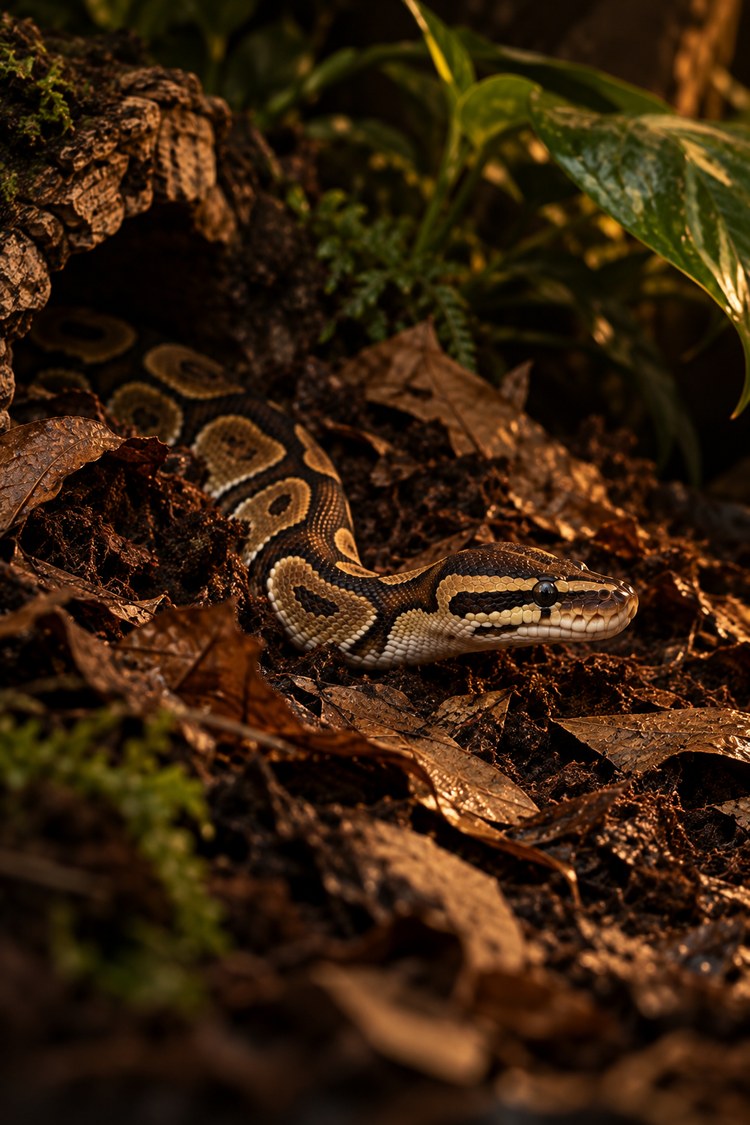
A study comparing rack housing with furnished terrariums found a much wider range of behavior in the terrariums. Basking, climbing, burrowing and bathing appeared only where the enclosure made them possible.
This leads to an important principle of ball python care: an animal cannot choose a behavior if its enclosure makes that behavior impossible.
Rack systems have played a major role in commercial ball python breeding. They save space and make large collections easier to manage. That does not make them the ideal standard for long-term welfare.
When the same ball pythons were compared in racks and in furnished terrariums, their behavior was far more restricted in the racks. Abnormal behaviors that may indicate stereotypies appeared almost only in rack housing.
A separate welfare assessment looked at about 5,000 ball pythons in the North American and European trade. Most were kept in enclosures too short to let them stretch out, and nearly all lacked adequate shelter.
For a pet or a permanent breeding animal, Hellish Reptiles recommends a properly furnished enclosure that offers real space, security and environmental choice.
The safest answer is no. Ball pythons should normally be housed alone.
Sharing an enclosure can create competition for heat, hides, water, space and the best microclimates. For instance, two snakes that seem to share a hide peacefully may in fact be competing for the same spot.
Temporary pairing for controlled breeding is different from permanent cohabitation. One snake per enclosure also makes feeding, fecal checks, health monitoring and quarantine much easier.
Feeding
Ball pythons are obligate carnivores. They need whole prey, which supplies muscle, organs, bone, fat and other nutrients together.
Appropriately sized rodents are the usual captive staple. For example, rats and mice are both suitable, and occasional prey variety can also be offered. A healthy snake eating complete whole prey generally does not need routine calcium or vitamin powder.
Whenever possible, offer frozen-thawed or freshly pre-killed prey. As a result, this protects both animals.
A live rodent can bite a snake badly, especially when the snake does not strike or eat it right away. Veterinary sources describe injuries ranging from small punctures to severe wounds and life-threatening infection.
Thaw frozen prey completely and warm it before feeding. Never microwave a frozen rodent, because heating can be uneven and may cause dangerous hot spots or rupture. Finally, use feeding tongs rather than your fingers.
Admittedly, there is no perfect prey formula for every snake.
A reasonable starting point is prey about as wide as the widest part of the snake’s body. Another common method uses prey weight as a share of snake weight, especially for growing juveniles.
However, body condition matters more than any fixed percentage. A growing juvenile and a mature, less active adult do not need the same energy. The feeding plan should change as the snake matures.
Generally, young snakes need to eat more often than adults. A useful general framework is:
| Life stage | General feeding interval |
|---|---|
| Young juveniles | About every 7 days |
| Growing juveniles | About every 7–14 days |
| Subadults | About every 10–21 days |
| Adults | Often every 2–4 weeks |
| Large mature adults | May need longer intervals, depending on body condition |
This is not a feeding law. Instead, monitor the individual snake. An adult should not be fed like a fast-growing hatchling just because it still takes food eagerly.
Unfortunately, overfeeding is extremely common. A ball python should look muscular, not like an overfilled tube. Possible signs of excess body fat include:
Do not “power feed” a ball python to force rapid growth. Faster growth is not automatically healthier growth.
Weigh the snake, but judge weight together with body condition, age and length. After all, two healthy snakes of the same weight can have very different body condition.
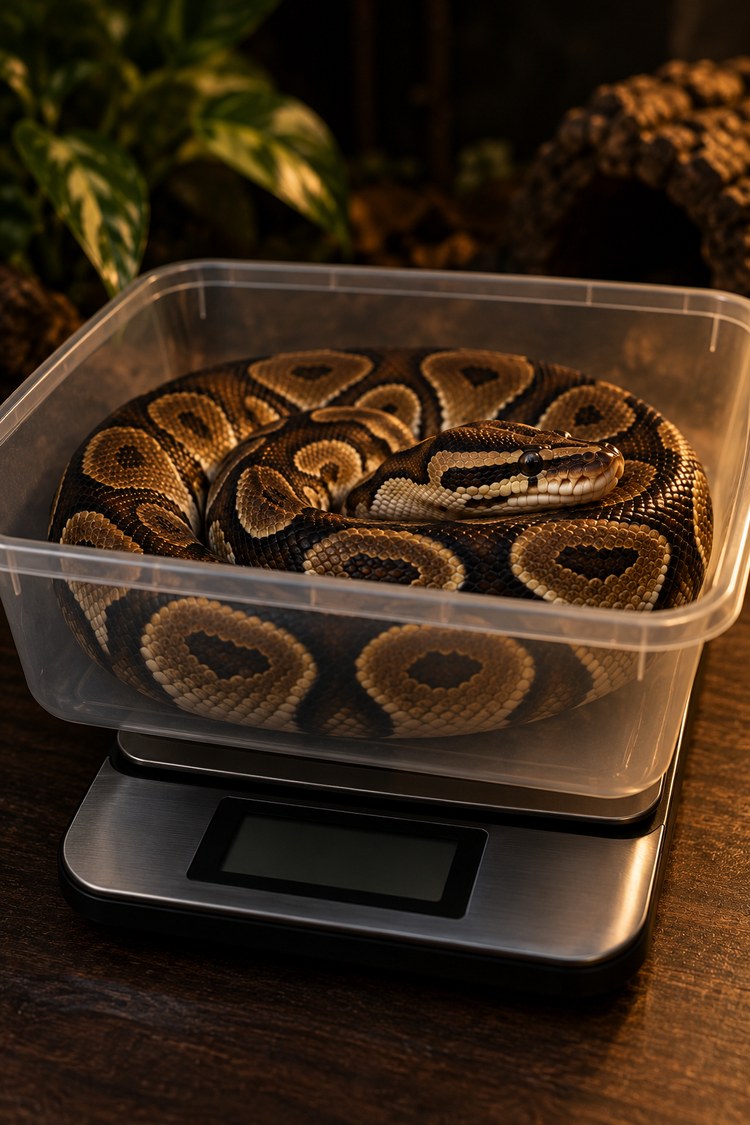
Notably, ball pythons are famous for refusing food.
Sometimes this happens with seasonal or breeding changes. Even so, a missed meal should never be brushed off as “just what ball pythons do.” Start by checking:
Meanwhile, weigh the snake regularly. A healthy adult that holds good body condition during a short fast is very different from a snake that refuses food while losing weight. Breathing problems, digestive signs or neurological signs make a fast more serious.
In a stable captive environment, many ball pythons keep eating through winter. So do not simply assume that every seasonal fast is normal.
There is usually no need. Feeding in the normal enclosure avoids extra handling before and after the meal. A separate feeding container does not stop a snake from developing a feeding response.
Instead, use tongs, a predictable routine and sensible handling. After a large meal, avoid handling for about 48 hours. This reduces stress and the risk of regurgitation.
Ball pythons are usually calm snakes. Even so, calm does not mean they need constant handling.
When you lift one, support its body. Do not let the snake’s weight hang from one point, and never restrain it more than necessary. Avoid handling:
First, give a new snake time to settle. Wait until it feeds and behaves normally before handling it often.
A snake curled tightly into a ball is telling you it feels defensive or insecure. It is better to give it space than to keep forcing interaction.
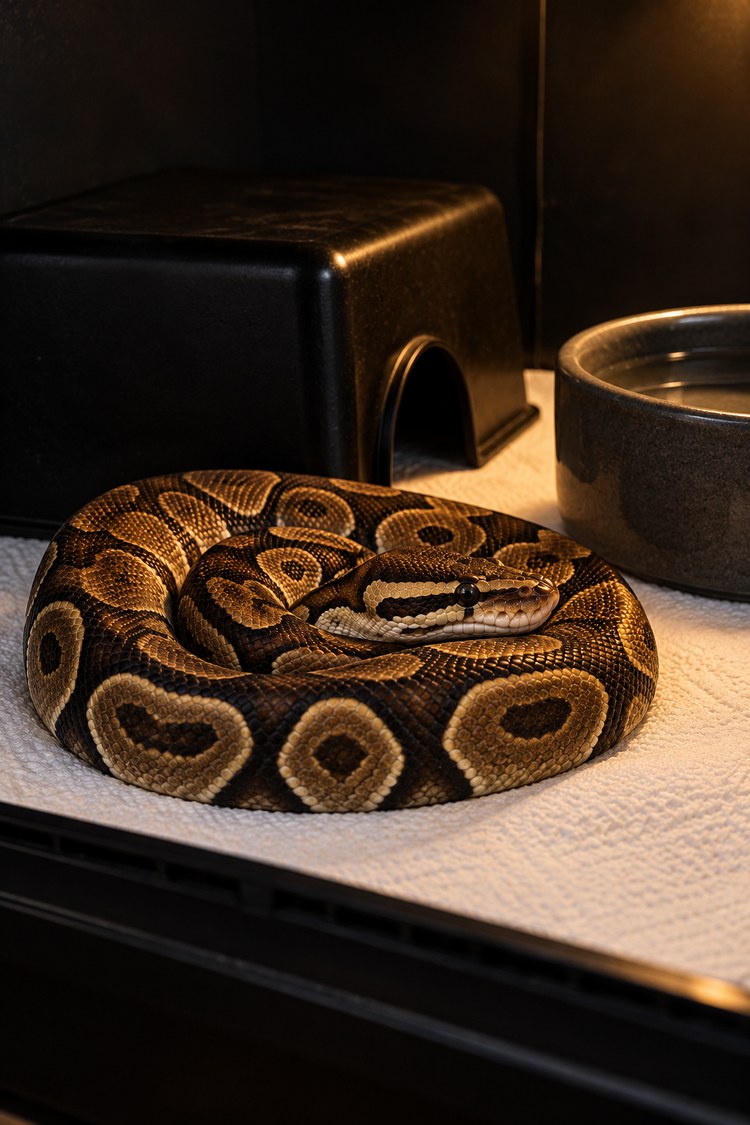
Every new snake should be quarantined away from established reptiles. This matters especially for ball pythons, because the species is widely bred, traded and moved between collections.
During quarantine, monitor:
Moreover, use separate equipment where possible and wash your hands between animals. A reptile-experienced veterinarian can advise on fecal testing, parasite screening and other checks. Above all, quarantine becomes more important as a collection grows.
Health
Many ball python health problems are strongly linked to husbandry. Correcting the environment is an important part of prevention, but a sick snake still needs a proper veterinary diagnosis.
Healthy snakes usually shed in one piece. Poor sheds can follow low humidity, dehydration, illness, parasites or a poor enclosure. Retained skin on the tail tip or eyes is a concern; never force off an eye cap.
Watch for wheezing, clicking, bubbles or mucus at the nose or mouth, open-mouth breathing, a raised head, lethargy and poor appetite. Causes can be bacterial, viral, fungal or parasitic. A reptile vet should examine the snake.
These tiny dark parasites spread fast through a collection. Look for mites around the eyes or under scales, extra soaking and rubbing. Heavy infestations can cause anemia, and the snake and its enclosure both need treatment.
Constantly wet or dirty substrate can lead to bacterial skin disease. Check the belly for redness, blisters, discoloration, damaged scales, swelling or ulcers. High humidity is not the same as wet, unsanitary conditions.
Stomatitis shows as swelling, red gums, thick material in the mouth, trouble closing the mouth, drooling or reduced feeding. It needs a veterinarian. Do not scrape the mouth or use household antiseptics.
Unguarded lamps, ceramic heaters, hot rocks and unregulated heat mats can burn a snake. Ball pythons do not always move away before damage occurs, so every heater must prevent direct contact.
Regurgitation is not normal. Causes include handling too soon after feeding, prey that is too large, low temperatures, stress, parasites and disease. Repeated episodes need a vet, and the next large meal should wait.
Contact a reptile-experienced veterinarian if you notice:
Snakes can hide illness surprisingly well. Changes in weight, behavior and body condition together usually tell you more than appetite alone.
Good ball python care includes simple records. Note:
Therefore, a gram scale is useful even for adult snakes. Photos taken from similar angles every so often can also reveal slow changes in body condition. Above all, good records become valuable if a health problem develops later.
What size enclosure does an adult ball python need?
At minimum, the enclosure should let the snake stretch out fully. A 4 × 2 × 2 ft enclosure is a useful baseline for many adults, but a snake longer than four feet needs more length.
What temperature should a ball python have?
Provide a warm area of about 86–90°F and a cooler area of about 75–80°F. The snake must be able to move freely between them.
What humidity should a ball python have?
About 60–80% is a useful general range. Avoid both chronically dry air and permanently wet substrate.
Do ball pythons need UVB?
Ball pythons get their vitamin D and calcium from whole prey, so they do not depend on UVB the way diurnal lizards do (see our day gecko care guide). Still, modern ball python care increasingly adds low-level UVB as part of a natural light gradient.
Can two ball pythons live together?
Housing each snake alone is the safest standard. Permanent cohabitation has no proven benefit, can cause competition and makes health monitoring harder.
How often should I feed my ball python?
Juveniles usually eat more often, while mature adults often need food only every two to four weeks. Adjust feeding to age, prey size, body condition and activity rather than a rigid calendar.
Is frozen-thawed prey better than live prey?
Yes. Properly prepared frozen-thawed prey avoids the serious bite injuries that live rodents can cause.
Why is my ball python not eating?
Common causes include relocation, stress, wrong temperatures, poor hides, shedding, seasonal or breeding changes, overly frequent feeding, prey preferences and illness. Track body weight and check the enclosure rather than assuming every fast is normal.
Ball pythons are resilient animals. That resilience helped create some outdated ideas about what they actually need.
A snake may eat, grow and breed in a very restricted environment. Those facts alone do not show whether it can behave normally.
Modern ball python care should provide more than survival. Give the snake room to stretch out fully. Give it secure hides without taking away its chance to explore. Provide a real temperature gradient, suitable humidity, fresh water, branches, substrate, darkness at night and choices between different parts of its home.
Then, above all, watch the individual animal.
A good enclosure does not force a ball python into one “correct” spot. It gives the snake enough choices to regulate itself.

 Ball Python Morphs & Genetics: Understanding Genes, Inheritance and Responsible...