Crested Gecko Morphs
Understanding Genetics, Genes and Modern Breeding
Understanding Genetics, Genes and Modern Breeding
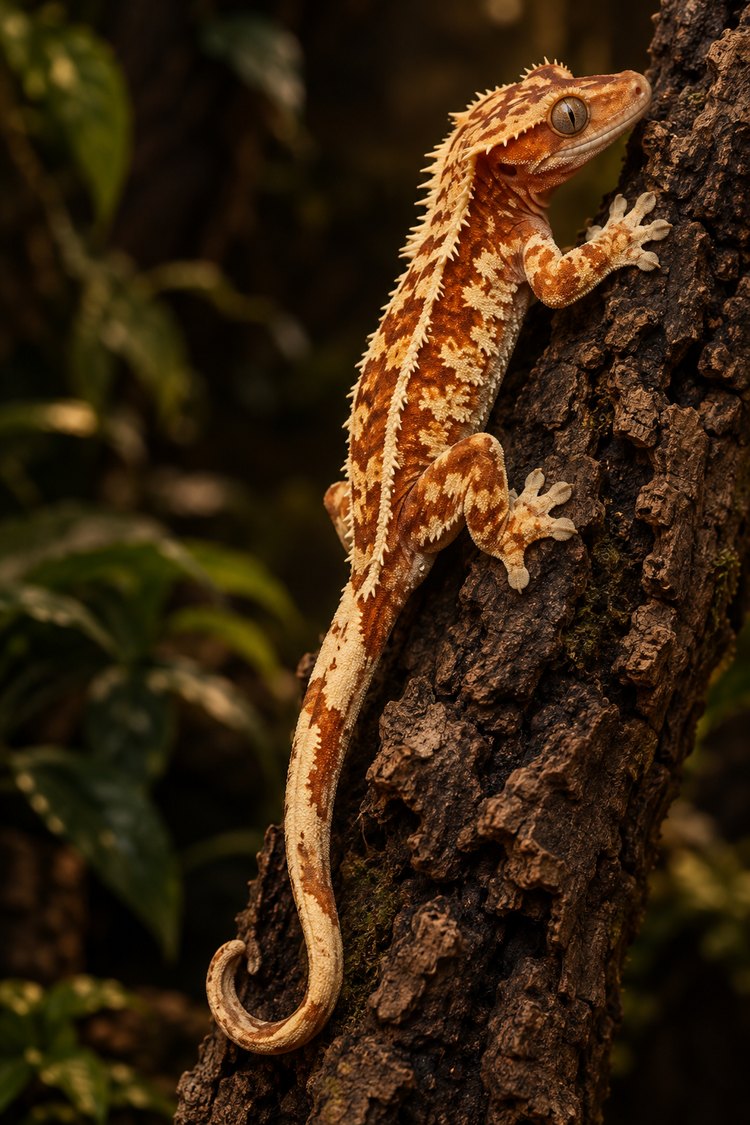
Few reptiles show as much visual variation as the crested gecko. Crested gecko morphs range from reds, creams and blacks to stripes, spots, white patterning and every combination in between.
That variety also creates confusion.
Search for crested gecko morphs, and you will quickly encounter words such as gene, trait, line, het, super, dominant, recessive and polygenic. They are often used as though they mean the same thing. They do not.
Some crested gecko traits follow relatively predictable inheritance. Others are the result of generations of selective breeding. Many familiar morph names simply describe what an animal looks like.
Understanding that difference is the starting point for understanding modern crested gecko genetics.
This guide explains the system without turning into a catalog of individual morphs. We will cover those separately.
In the reptile hobby, a morph is a recognizable variation in appearance within a species.
A morph may involve:
However, the word morph does not automatically mean single-gene mutation.
That distinction matters.
A Harlequin-looking gecko and a gecko carrying a proven recessive mutation may both be described as morphs, but their inheritance can work very differently.
For that reason, the name written on a breeder’s label does not tell you everything about the animal’s genetics.
Four terms appear constantly in discussions of crested gecko morphs.
Understanding them prevents a surprising amount of confusion.
| Term | Practical meaning |
|---|---|
| Morph | The overall recognizable appearance or named form of an animal |
| Trait | A particular characteristic contributing to that appearance |
| Gene | A section of DNA involved in a biological characteristic |
| Line | A family of animals selectively bred over generations for particular characteristics |
One crested gecko can display several traits at the same time.
For example, its base color, dorsal pattern, lateral pattern, spotting and genetically inherited mutation may all contribute to its final appearance.
The morph name may describe only part of that picture.
This is one of the most useful concepts in crested gecko genetics.
A genotype describes the genetic information an animal carries.
A phenotype describes what you can observe.
Those two things are connected, but they are not identical.
A recessive mutation can be present in the genotype without appearing visually. Meanwhile, a visually impressive line-bred trait may have no simple one-gene explanation.
Environment can also affect phenotype.
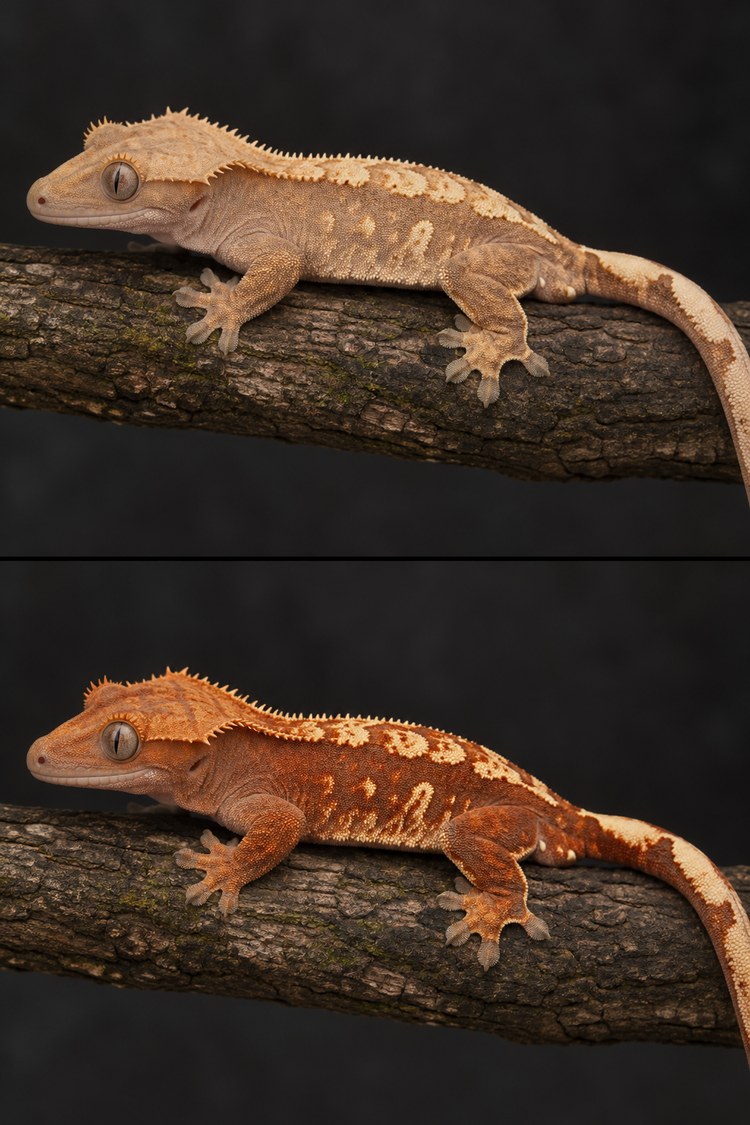
A crested gecko may look dramatically different depending on whether it is fired up or fired down. Age, shedding, temperature, stress, lighting and photography can also change how color and contrast appear.
That is why photographs alone cannot always establish genetics.
Inheritance
Every crested gecko inherits genetic information from both parents.
A gene occupies a particular position on a chromosome. That position is called a locus.
Different versions of genetic information at that locus are called alleles.
A gecko normally receives one allele from its mother and one from its father.
Those alleles can interact in different ways. That interaction helps determine what the offspring looks like and whether a trait can remain hidden.
This is where dominant, recessive and incomplete-dominant inheritance enter the picture.
With a simple recessive trait, an animal generally needs two copies of the relevant allele to display the visual phenotype.
A gecko carrying only one copy can appear visually normal for that trait.
That animal is usually called heterozygous, or het, for the recessive trait.
This is why lineage becomes extremely important.
You cannot reliably identify every recessive carrier by appearance.
If two known heterozygous animals are bred together, the theoretical expectation for each offspring is:
| Genotype | Probability |
|---|---|
| Visual recessive | 25% |
| Heterozygous carrier | 50% |
| Non-carrier | 25% |
However, these percentages are probabilities—not promises.
Four eggs do not guarantee one visual animal, two carriers and one non-carrier. Every offspring represents another genetic event.
Over large numbers of offspring, results tend to move closer to expected ratios. Small breeding groups can differ substantially.
A dominant trait can become visible when only one copy of the relevant allele is present.
With an incomplete-dominant trait, the phenotype associated with one copy differs from the phenotype produced by two copies.
That means breeders may distinguish between:
Some well-known crested gecko projects follow inheritance patterns that breeders classify this way.
However, an important warning belongs here.
A homozygous form is not automatically desirable simply because it represents two copies of a trait.
Some genetic combinations in crested geckos have serious developmental or health consequences. Responsible breeding requires understanding the entire genetic outcome of a pairing, not merely the possibility of producing a more visually extreme animal.
The word super causes particular confusion in crested geckos.
In proper genetic use, a super may describe the homozygous form of an incomplete-dominant trait.
But crested gecko breeders have historically also used super as a visual description.
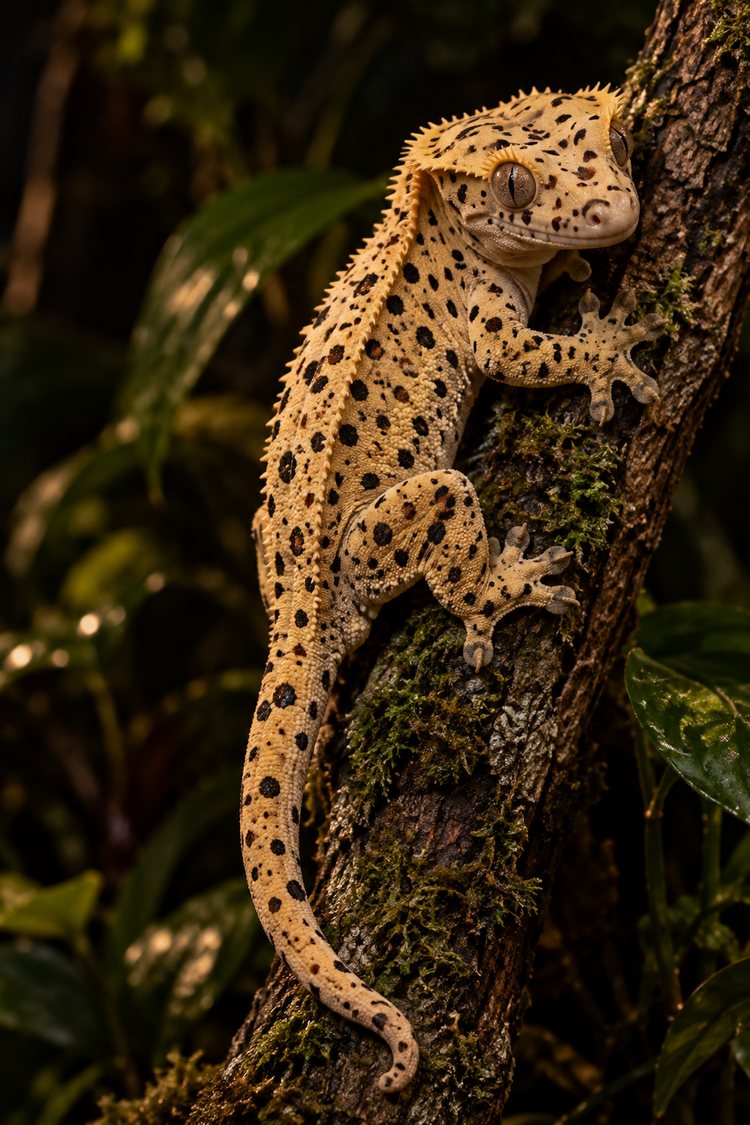
For example, a name such as Super Dalmatian traditionally describes an animal with unusually extensive spotting. It does not automatically mean the animal is homozygous for a proven single-gene mutation.
The same problem appears with other appearance-based names.
“Super” in a morph name does not necessarily mean “homozygous.”
Always determine how the underlying trait actually inherits before using genetic terminology.
Het is short for heterozygous.
The term is most useful when discussing recessive genetics.
A visual recessive animal generally has two copies of the recessive allele. A heterozygous carrier has one copy and may not visually show the trait.
You may also encounter terms such as:
A possible het should never be represented as genetically confirmed unless breeding records or future genetic testing establish that status.
Line Breeding
Crested geckos were visually diverse long before modern morph breeding began.
Their captive population contains substantial variation in color and pattern. Breeders then selected animals displaying desirable characteristics and paired similar animals over generations.
That process produced many of the spectacular animals seen today.
But it also means that much of crested gecko appearance cannot be explained with a simple Punnett square.
Traits such as the amount of cream, depth of red, pattern coverage, stripe quality and other visual characteristics can be influenced by multiple genetic factors.
These are commonly discussed as polygenic or line-bred traits.
A polygenic characteristic is influenced by more than one gene.
Human height is a familiar example. There is no single “tall gene” that lets you calculate everyone’s final height with a basic 25%, 50% or 75% probability.
Many crested gecko appearance traits behave more like this.
Breeding two animals with excellent expression may increase the likelihood of producing desirable offspring, but it does not guarantee that every hatchling will equal or exceed its parents.
This explains an experience familiar to breeders: spectacular parents can occasionally produce relatively ordinary offspring, while an apparently modest animal from a strong lineage can produce exceptional young.
Genetics exist beyond what the eye can see.
Line breeding is selective breeding designed to strengthen particular characteristics across generations.
A breeder may select for deeper coloration, cleaner patterning, greater lateral coverage, stronger striping or another desired characteristic.
Over time, those selections can produce a recognizable family or line.
That line may become remarkably consistent.
Still, consistency does not automatically prove that the characteristic comes from a single gene.
This is one of the biggest differences between a proven genetic mutation and a refined line-bred phenotype.
With crested geckos, knowing the parents can sometimes tell you more than looking at the animal itself.
A young gecko may change dramatically as it develops. Pattern may increase. White or cream may become more pronounced. Base coloration can deepen. Some characteristics become easier to identify only with age.
Lineage can reveal what an animal may carry or what characteristics consistently appear in its family.
That is why serious breeders preserve:
Good records become more valuable with every generation.
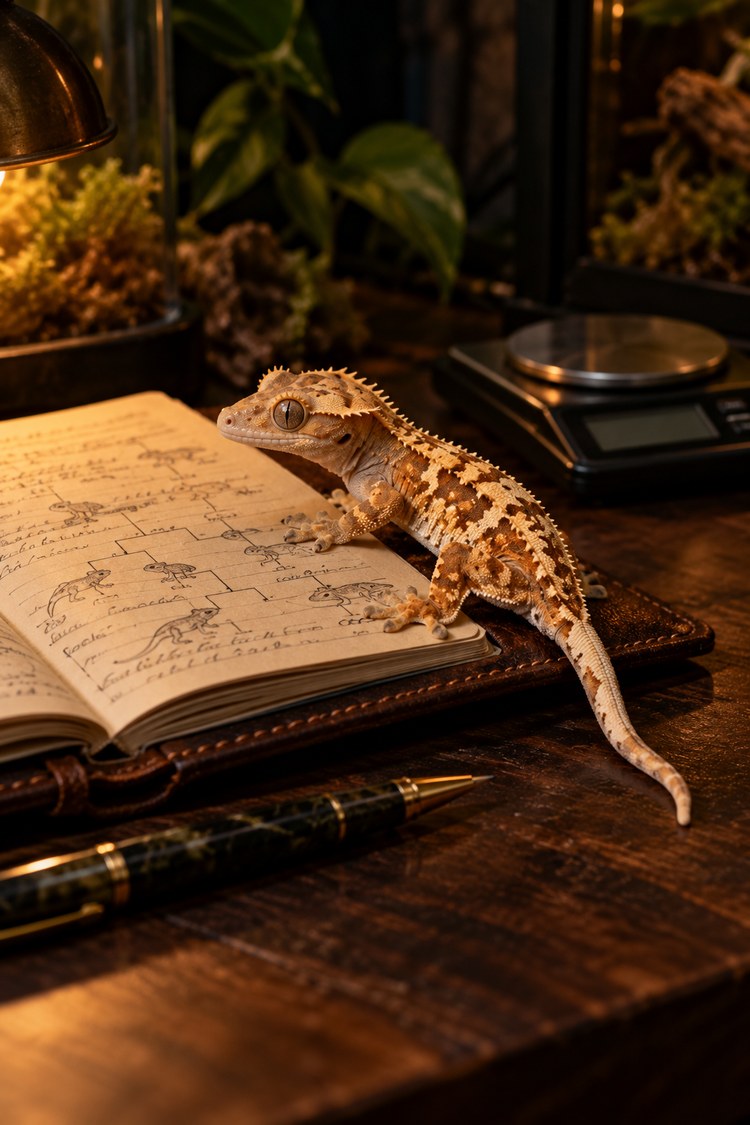
Crested gecko morph identification should never rely on one photograph alone when genetics matter.
A photograph can be affected by lighting, white balance, editing, camera exposure and the animal’s current fired state.
Age creates another problem.
A hatchling can look quite different from the same animal a year later.
Furthermore, several unrelated genetic or line-bred traits can sometimes produce superficially similar appearances.
A dark animal is not automatically a particular dark morph. A high-white animal is not automatically carrying a specific white-producing mutation.
Phenotype is evidence. It is not always proof of genotype.
When more than one recognizable genetic or visual trait occurs in the same animal, breeders often describe the result as a combination morph, or combo.
Some combinations involve separate genetic loci. Others combine a known genetic mutation with line-bred characteristics.
This is where crested gecko terminology can become complicated very quickly.
One animal might simultaneously have a genetic mutation, a particular pattern type, strong white coverage, spotting and a selectively developed base color.
Giving that animal one long morph name does not mean every component follows the same inheritance mechanism.
Each trait must be considered separately.
Another important development in modern crested gecko genetics is the study of traits that may occupy the same genetic locus.
When different mutations represent alternative versions of the same gene, they are described as allelic.
Instead of behaving like two completely independent genes, those alleles interact at one locus.
This can create a genetic complex in which different allele combinations produce different phenotypes.
Breeder work involving the Cappuccino, Sable and Highway projects has become one of the most discussed examples in the crested gecko community.
The evidence continues to develop, and this is exactly why careful record keeping matters.
A breeding theory becomes much more valuable when breeders can reproduce it across generations and independent lines.
The Science
An unusual hatchling is not automatically a new gene.
Neither is an unusual animal purchased from another breeder.
A suspected genetic trait needs repeatable breeding evidence.
The process can take years.
A breeder must reproduce the characteristic, follow it through generations, compare expected and actual offspring, study related animals and determine whether another known trait could explain the result.
Ideally, independent breeders should eventually reproduce those findings.
Even then, there is an important scientific distinction.
A trait can become strongly breeder-supported without researchers having identified the exact DNA mutation responsible.
That describes much of current crested gecko genetics.
This distinction deserves special attention.
Many inheritance patterns in the crested gecko hobby are supported by extensive breeding records. Some produce highly predictable results across generations.
That is meaningful evidence.
However, it is not the same as identifying the causal mutation through DNA sequencing and controlled scientific study.
As of 2026, scientific research has not yet molecularly mapped most familiar crested gecko morphs to specific causal DNA variants.
Therefore, a careful description might say:
“Breeder-established incomplete-dominant trait.”
That wording is more accurate than suggesting that scientists have already identified and validated the responsible gene.
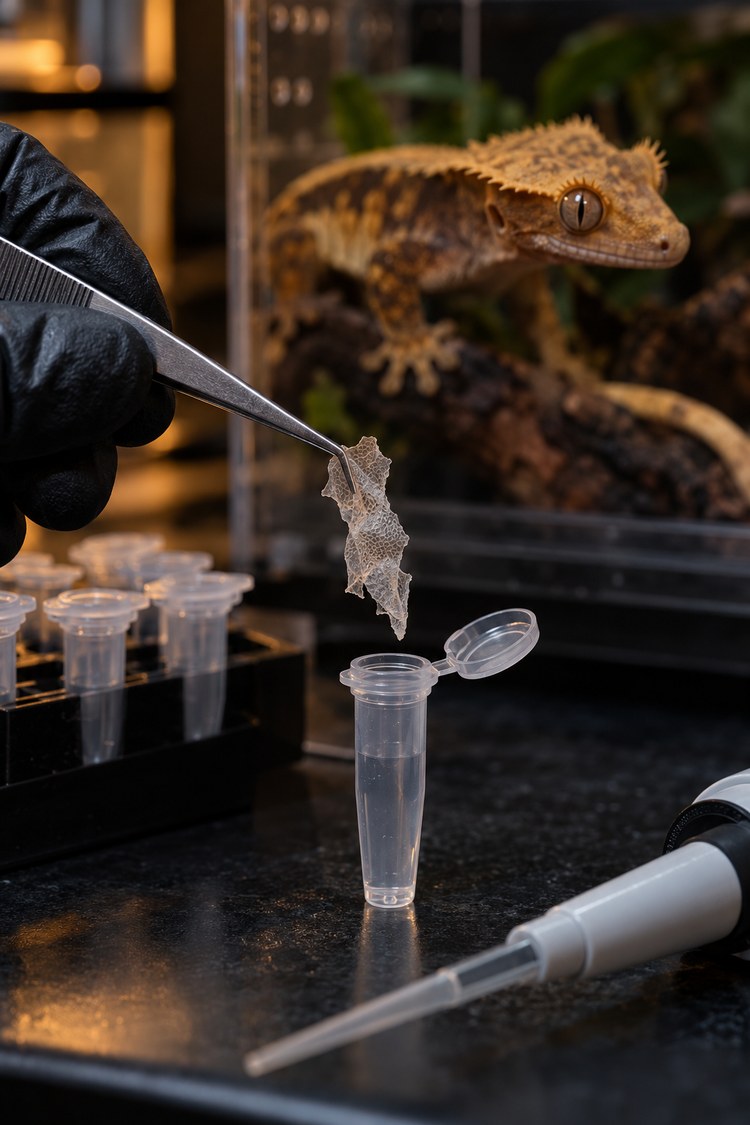
Crested gecko genetics entered an important new phase recently.
Since late 2024, researchers have published chromosome-level genome assemblies of Correlophus ciliatus.
One of these assemblies is about 1.66 billion base pairs long. Of that sequence, 99.52% is anchored to 19 chromosomes. Researchers annotated more than 21,000 protein-coding genes.
Why does that matter to breeders?
A reference genome gives researchers a map against which genetic differences can eventually be compared.
In the future, DNA from animals with and without particular traits could potentially help researchers identify mutations associated with individual morphs.
That does not mean we currently have commercial DNA tests for every crested gecko morph.
We do not.
But scientifically, the foundation now exists for a much deeper understanding than the hobby had only a few years ago.
The most important change in the hobby is not simply the appearance of new morph names.
It is the movement toward evidence.
Breeders are increasingly separating predictable genetic mutations from line-bred appearance traits. More attention is being given to allelic interactions, homozygous forms, pedigree documentation and long-term health.
This matters because discovering how a trait is inherited is only half the job.
We also need to know what that trait does to the animal.
In September 2026, a collaborative breeder update raised serious welfare concerns. It reported that several homozygous and compound Cappuccino/Sable/Highway forms are often fatal within the first two years. Breeders are advised not to produce them.
That development should change how responsible breeders think about genetics.
A pairing should never be considered successful simply because it produces a rare phenotype.
Health must be part of the genetic equation.
Responsible Breeding
Breeding for appearance without considering structure, health, fertility and genetic diversity is short-sighted.
A visually extraordinary gecko can still be a poor breeding candidate.
Responsible breeders should consider the entire animal:
Genetic projects should not knowingly reproduce harmful outcomes.
Strong body structure matters beyond appearance.
Helps identify genetics, relationships and previous outcomes.
Excessive close breeding can concentrate harmful alleles.
Useful information when evaluating breeding animals.
A successful project requires healthy reproductive animals.
New morphs should be monitored beyond the hatchling stage.
Appearance remains important, but should not be the only criterion.
When a desirable trait originates from very few animals, breeders face an immediate problem.
The easiest way to reproduce it quickly may involve closely related animals.
That can also concentrate unwanted recessive alleles and reduce genetic diversity.
Responsible breeding programs therefore use outcrossing.
An outcross introduces an unrelated or less-related animal into the project. Breeders can then work the desired trait back into future generations while broadening the genetic base.
Outcrossing can temporarily reduce visual consistency.
That is not necessarily a failure.
A healthier, genetically diverse project is more valuable over the long term than a rapidly intensified trait built on repeated close inbreeding.
Modern crested gecko breeding increasingly depends on documentation.
A morph name without lineage has limited genetic value.
At minimum, serious breeding records should preserve the identity of both parents, breeder or source, hatch date, known genetics, pairing history and offspring results.
Photographs over time are especially useful.
When an unexpected hatchling appears years later, those records may become the evidence that explains it.
This is also why pedigree systems are becoming increasingly valuable within the hobby.
Genetics is cumulative knowledge. Without records, much of that knowledge disappears every generation.
Genetic calculators, including our Crested Gecko Morph Calculator, are useful tools.
They can show theoretical Mendelian probabilities for traits whose inheritance is sufficiently understood.
However, they cannot evaluate the whole breeding decision.
A calculator does not know whether the animals are closely related. It cannot determine whether their structure is poor. It does not automatically know the latest health information surrounding every new genetic combination.
And it cannot reliably calculate ordinary polygenic traits in the same way it calculates a simple recessive allele.
Use a calculator to understand probability, not to replace judgment.
One reason crested geckos remain so interesting is that the genetic picture is unfinished.
Some traits that breeders once believed were purely line bred may eventually prove to contain stronger single-gene components.
Other traits currently described as genetic may require refinement as more breeding data becomes available.
Allelic relationships may become clearer.
New mutations will almost certainly appear.
And eventually, molecular testing may allow breeders to verify at least some morph genetics directly from DNA.
Until then, there is nothing wrong with saying:
We do not know yet.
That is better science than turning an attractive theory into a fact.
What is the rarest crested gecko morph?
There is no permanent answer. New projects appear, populations expand and availability changes quickly. Rarity also does not indicate quality, health or genetic importance.
Are all crested gecko morphs genetic?
Their appearance ultimately has a genetic component, but not all morph names describe a simple single-gene mutation. Many describe polygenic, selectively bred or combined phenotypes.
What does het mean in crested geckos?
Het means heterozygous. In practical breeding language, it most often describes an animal carrying one copy of a recessive allele without visually expressing the recessive phenotype.
Can you identify a crested gecko’s genes from a photo?
Not reliably in every case. Some visual mutations can be strongly recognizable, but appearance alone cannot reveal every recessive carrier or distinguish every similar-looking trait. Lineage and breeding records are essential.
What does line bred mean?
A line-bred trait has been selectively developed through generations of breeding animals with desired characteristics. It does not necessarily follow a simple single-gene inheritance pattern.
What does super mean?
It depends on the trait. In some genetically established incomplete-dominant traits, super describes a homozygous animal. In other morph names, the word simply describes unusually strong visual expression.
Can two beautiful crested geckos produce better offspring?
They can, but there is no guarantee. Polygenic traits, hidden genetics and genetic recombination mean offspring can vary significantly even within a single clutch or pairing.
Are Punnett-square probabilities guaranteed?
No. They describe the probability for each offspring. Actual results from a small number of eggs can differ substantially from the expected percentages.
For years, crested gecko breeding was driven largely by appearance and lineage.
That is changing.
Visual selection still matters, but genetics, pedigrees, long-term health records and collaborative breeding data are becoming increasingly important.
The publication of chromosome-level crested gecko genomes gives science a foundation that did not previously exist. At the same time, breeders are producing more detailed multi-generation records and identifying genetic combinations that require caution or should not be produced.
The next stage of the hobby should not be about creating the longest morph name.
It should be about understanding what those names actually mean.
Breed for the animal first. Understand the genetics. Preserve the lineage. Let appearance come after that.

 Day Gecko Care: A Complete Guide to Phelsuma Husbandry and Health