Day Gecko Care
The Complete Guide to Day Gecko Husbandry, Care and Health

The Complete Guide to Day Gecko Husbandry, Care and Health
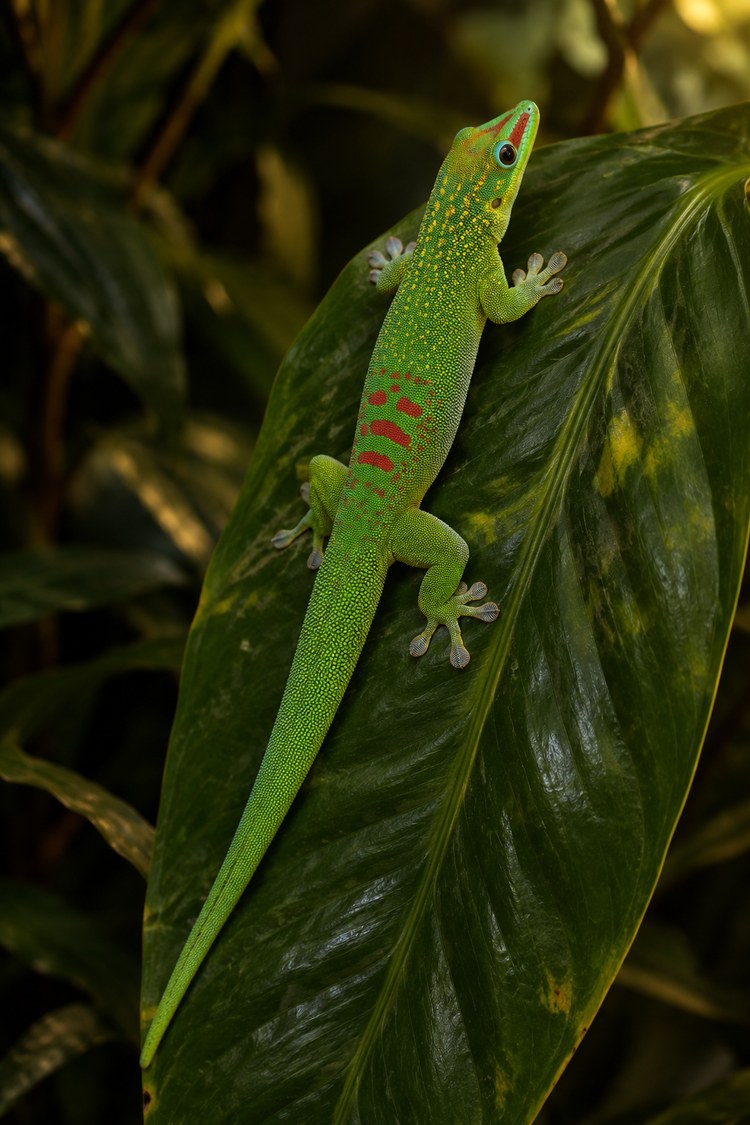
Bright green skin, red markings, oversized eyes and an ability to run across glass make day geckos easy to recognize. Day gecko care, however, is easy to get wrong.
They are also sometimes misunderstood.
Good day gecko care is not simply a humid terrarium, some insects and a light overhead. These are active, visually oriented, diurnal geckos that use heat, bright light, UVB, vegetation and vertical space throughout the day.
Most day geckos kept in captivity belong to the genus Phelsuma. The group includes tiny species only a few inches long as well as substantially larger animals such as the Madagascar giant day gecko. Many originate from Madagascar and neighboring islands of the western Indian Ocean.
That diversity matters. There is no single temperature or humidity number that is correct for every Phelsuma species.
This guide explains the principles that apply to most commonly kept day geckos and, just as importantly, where species-specific research should take over.
| Care factor | General approach for commonly kept Phelsuma |
|---|---|
| Lifestyle | Diurnal and primarily arboreal |
| Enclosure | Tall, well-ventilated and heavily furnished |
| Basking | Warm basking area with a cooler retreat available |
| UVB | Recommended as a normal part of day gecko husbandry |
| Visible light | Bright daytime illumination |
| Humidity | Moderate to high for many species, with natural daily variation |
| Diet | Live invertebrates plus an appropriate nutritionally complete fruit/nectar-style gecko diet |
| Water | Fresh water plus drinking droplets from misting |
| Housing | Individual housing is the safest default |
| Handling | Minimal; day geckos have delicate skin and are extremely fast |
| Lifespan | Many species can live roughly 10–15 years or longer in good captive conditions |
These general day gecko care principles are a starting point. Always research the exact species you keep before deciding on temperatures, humidity, UV exposure or enclosure size.
Many popular pet geckos are most active at night or around dusk.
Day geckos are different.
Phelsuma are strongly diurnal. Their daily behavior includes basking, searching foliage and branches for food, watching their surroundings and moving between areas of different light and temperature.
Their husbandry therefore needs to reproduce more than warmth.
A well-designed enclosure provides distinct zones of heat, UVB, bright visible light, shade and cover.
The animal should be able to choose.
That principle—giving the gecko useful environmental choices—is more important than trying to make every part of the enclosure identical.
Habitat
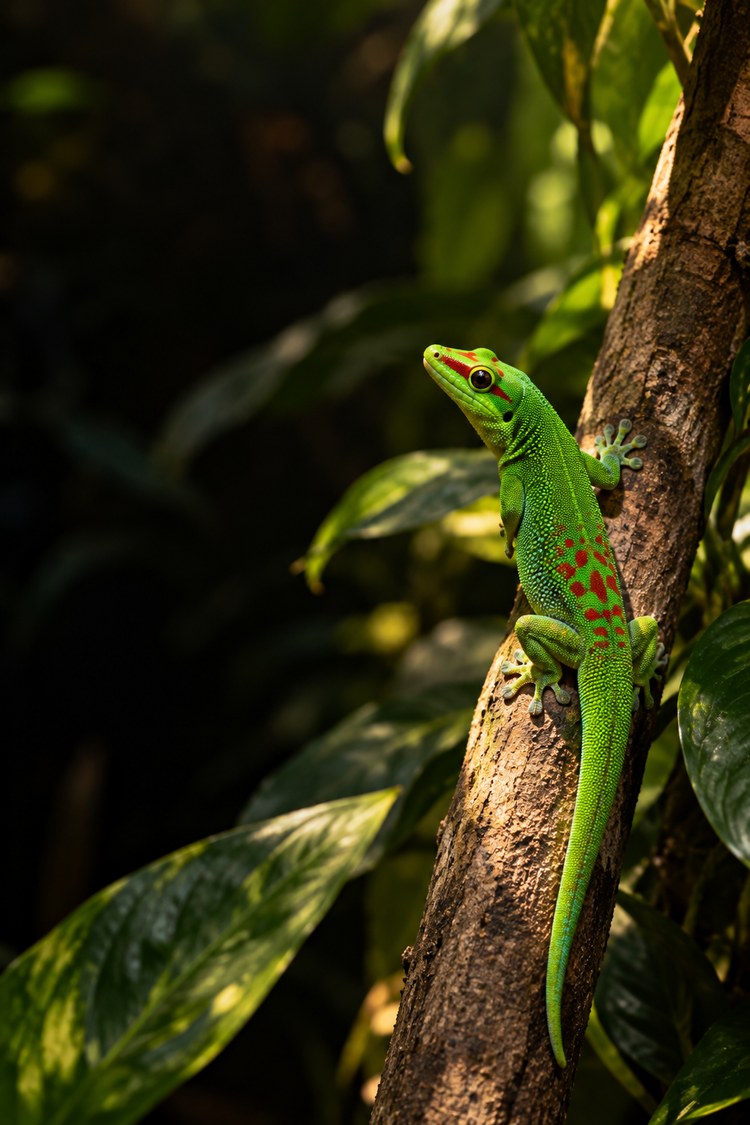
Most Phelsuma are arboreal. They spend much of their time on trunks, branches, bamboo, leaves and other elevated surfaces.
For that reason, vertical space is essential.
A small species such as a Gold Dust or Neon Day Gecko requires far less space than a Madagascar Giant Day Gecko, so one universal minimum enclosure size would be misleading.
As a rough comparison, modern husbandry recommendations commonly begin around 12 × 12 × 18 inches for a single small Phelsuma, while a large adult Giant Day Gecko deserves something closer to 24 × 24 × 48 inches or larger.
Treat those dimensions as starting points, not targets to avoid exceeding.
The enclosure must also be secure. Day geckos are fast, excellent climbers and capable of exploiting surprisingly small escape routes.
The inside of the enclosure matters as much as its external dimensions.
Provide branches and climbing surfaces at different heights and angles. Bamboo is especially useful for many Phelsuma, but it should not be the only structure available.
Dense foliage creates visual security. Open areas near the top allow basking. Horizontal and diagonal branches create natural resting locations. Broad leaves can hold water droplets after misting.
The finished enclosure should contain both exposed areas and sheltered ones.
If every branch sits under the lights, the gecko cannot escape them.
If every part is heavily shaded, it cannot bask effectively.
Good enclosure design creates both.
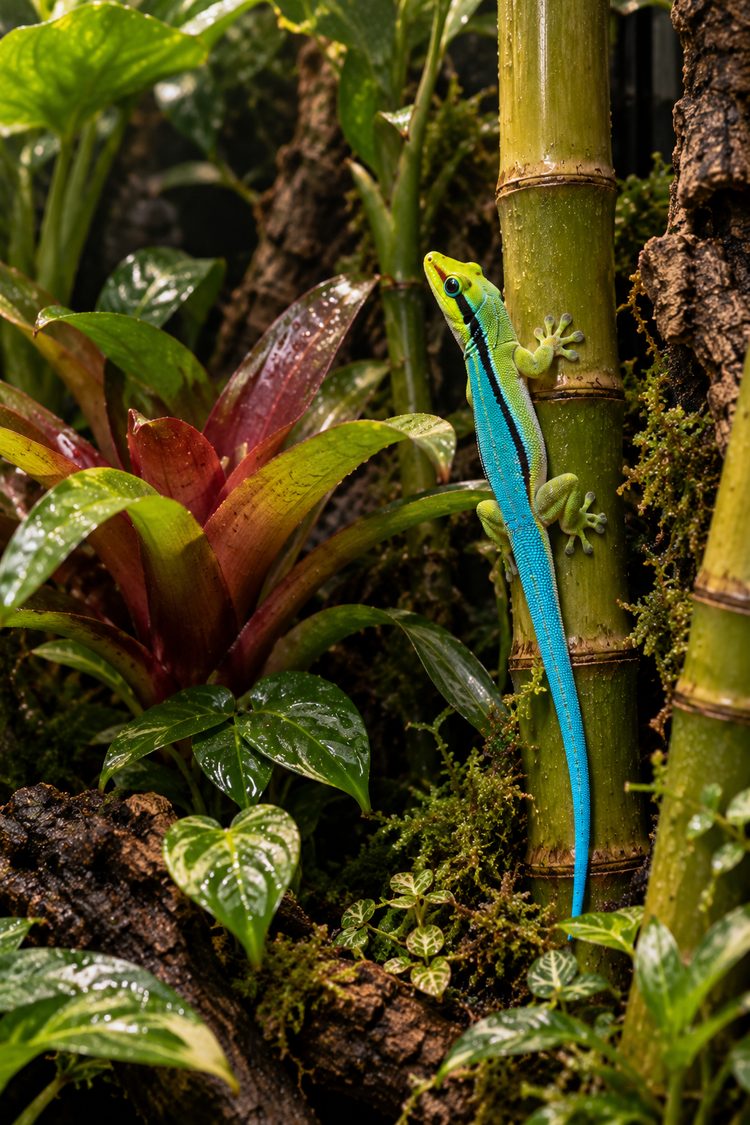
Day geckos are particularly well suited to planted tropical enclosures.
Live plants can provide cover, climbing surfaces, visual barriers and localized humidity. They also make it easier to create the layered environment these geckos naturally use.
Bioactive setups can work very well, but “bioactive” does not mean maintenance-free.
Food residue, feces, contaminated surfaces and dead plant material still need attention. Drainage, ventilation and substrate condition must be monitored.
For a newly acquired animal, a simpler enclosure can sometimes be useful initially because feces, appetite and general condition are easier to observe.
Heat & Light
This is one area where a generic care sheet can become dangerous.
Different Phelsuma species occupy different habitats and use heat differently.
For several commonly kept species, a basking surface somewhere around the mid-80s to low-90s°F is a reasonable starting region. However, that should never be converted into a rule for the entire genus.
Published evidence-based UV and husbandry work, for example, lists basking surface temperatures of approximately 86–95°F for Phelsuma klemmeri and P. grandis, while P. standingi may use considerably warmer basking surfaces.
The lesson is simple:
Research the species, then create a gradient.
Do not heat the entire enclosure to the basking temperature.
The gecko should be able to warm itself near the top and move into progressively cooler areas elsewhere.
Measure basking surface temperature with an infrared thermometer and ambient air temperatures with reliable digital probes.
Do not judge temperature by touching the glass or branch with your hand.
An arboreal enclosure can heat much faster than expected because the animal may climb within inches of the lamp.
This creates two risks.
The first is excessive enclosure temperature. The second is direct thermal injury.
Day geckos are capable of climbing upside down under mesh lids, so a heating element positioned too close to the top can create a burn hazard.
Therefore, position heat sources so that the gecko cannot contact dangerously hot surfaces.
A dimming thermostat is valuable when supplemental basking heat is used.
Day geckos do not need daytime basking temperatures throughout the night.
A normal nighttime cooling period is part of the environmental cycle.
The correct nighttime temperature varies by species. Published guidance for several popular species lists nights of roughly 72–77°F (22–25°C). Some species tolerate cooler nights, so check the needs of your species.
Unless the room becomes too cold for the species, nighttime heat may not be necessary.
Do not use bright or colored night lamps simply to keep the enclosure illuminated. The animal needs a dark period.
Day geckos are active under daylight and naturally encounter ultraviolet radiation.
Providing appropriate UVB is therefore a major part of modern Phelsuma husbandry.
UVB allows reptiles to synthesize vitamin D3, which is involved in calcium metabolism. Inadequate UVB, inappropriate nutrition and poor thermal conditions can all contribute to nutritional secondary hyperparathyroidism, commonly called metabolic bone disease. Veterinary literature identifies this as one of the most important nutrition- and husbandry-related diseases in captive reptiles.
Several commonly kept Phelsuma, including Giant, Standing’s and Yellow-Headed Day Geckos, have been assigned to Ferguson Zone 3 in published UV husbandry guidance.
In practical captive husbandry, a basking-zone UV Index around 3–4 is commonly recommended for several popular species.
Again, species matters.
Do not buy a bulb based only on a label such as “5%” or “6%.” Fixture design, distance, mesh obstruction and reflector efficiency can dramatically change the radiation that actually reaches the animal.
A UV meter is the most reliable way to know what the gecko receives.
And remember: ordinary glass blocks useful UVB. Sunlight coming through a closed window is not a substitute for properly provided UVB.
UVB and visible light are not the same thing.
A terrarium can have adequate UVB while still appearing dim.
Day geckos evolved as highly visual daytime animals. Bright full-spectrum visible illumination helps create a much more realistic daytime environment and also benefits live plants.
A roughly 12-hour light / 12-hour dark schedule is a practical general starting point. Some keepers adjust day length seasonally, and published husbandry recommendations for different Phelsuma often use approximately 11–14 hours depending on species and season.
Timers make consistency simple.
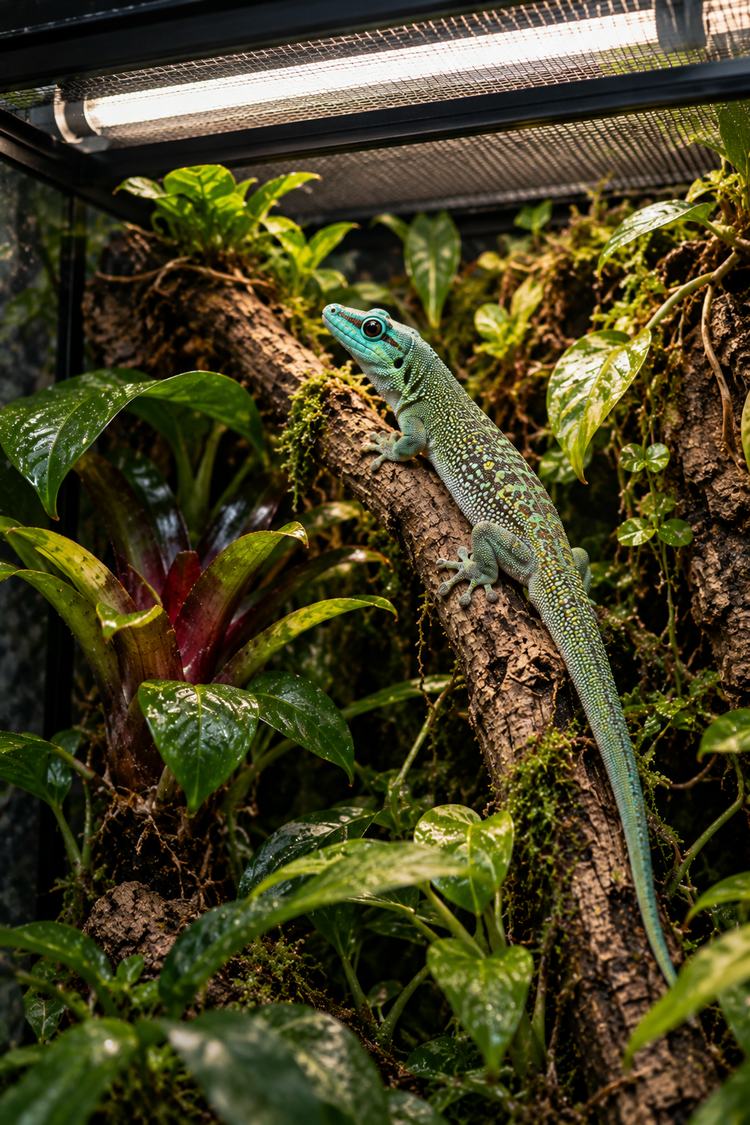
Many day geckos come from humid tropical environments, but tropical does not mean permanently soaked.
Humidity should vary through the day.
Misting creates a temporary rise in humidity and places drinking droplets on leaves and enclosure surfaces. Between mistings, good ventilation allows surfaces to begin drying.
Species requirements differ considerably. Modern husbandry guidance for commonly kept Phelsuma ranges from roughly 40–70% for Gold Dust Day Geckos to substantially higher average humidity for species such as the Blue-Tailed Day Gecko.
That variation is exactly why “keep a day gecko at 80% humidity” is poor general advice.
Research the species and monitor the enclosure with a digital hygrometer.
A healthy tropical setup balances humidity with airflow.
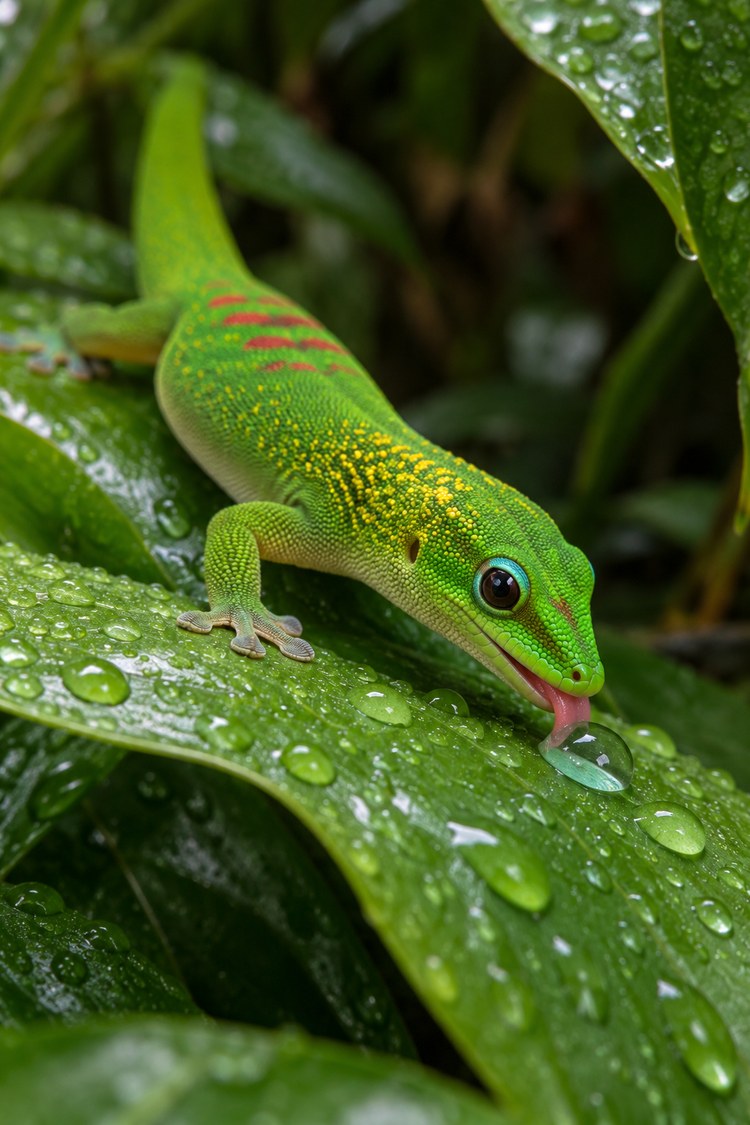
Day geckos commonly lick droplets from leaves, branches and enclosure surfaces. Field research also confirms the importance of nectar and liquid plant resources to Phelsuma ecology; several species even function as pollinators while feeding from flowers.
Misting therefore serves two purposes: humidity management and drinking opportunity.
Still, provide clean fresh water in a shallow elevated dish as well.
Some individuals may rarely be observed using it. That does not make it unnecessary.
Diet & Daily Care
Most commonly kept Phelsuma are omnivorous.
They consume arthropods, but many species also eat nectar, soft fruit material and other sugar-rich plant foods. Wild observations and ecological studies document nectar feeding directly, including Phelsuma acting as pollinators.
In captivity, the most practical diet combines:
appropriately sized live feeder insects + a nutritionally complete fruit/nectar-style gecko diet.
That is considerably safer than trying to recreate the plant portion of the diet with honey, baby food or mashed fruit alone.
Plain fruit can be used occasionally where appropriate, but it should not become the nutritional foundation.
Honey is especially easy to overuse because geckos readily consume sweet foods.
Something being eagerly eaten does not make it nutritionally complete.
Use appropriately sized prey that the gecko can capture safely.
Crickets, suitable roaches, locusts, silkworms and other quality feeder insects can be rotated depending on the size and species of gecko.
Variety is preferable to relying permanently on one feeder.
Feed insects well before offering them to the gecko. Captive feeder insects also commonly require appropriate calcium supplementation.
A complete prepared gecko diet already contains vitamins and minerals, so supplementation must consider the whole diet. Randomly adding calcium, vitamin D3 and multivitamins to everything can create its own problems.
UVB provision, age, reproductive status and the specific diet being used all affect supplementation decisions.
Young, growing geckos need food more frequently than mature adults.
Rather than following one universal feeding calendar, adjust frequency to the species, age, body condition and type of foods being offered.
Adults usually need substantially less food than rapidly growing juveniles.
Watch body condition carefully. Day geckos can become overweight when calorie-dense prepared diets, fruit and insects are offered too generously.
An animal eating eagerly is not evidence that it needs more food.
Day geckos are often described as animals that can live in pairs.
That requires context.
Some Phelsuma have indeed been maintained and bred successfully in pairs or groups. But successful breeding housing does not automatically make cohabitation the best choice for a pet.
Territorial behavior is well documented in Madagascar day geckos, and direct aggression between individuals occurs.
Never house two males together.
Male-female pairs can involve persistent breeding pressure. Females can also compete or injure one another.
For a keeper who does not have a specific breeding purpose, one day gecko per enclosure is the safest default.
Experienced breeders who deliberately pair animals should provide sufficient space, multiple resources and visual barriers, and should be ready to separate the animals immediately.
This is one of the most important differences between day geckos and many other popular reptiles.
Their skin is extremely delicate.
A frightened day gecko that is grabbed can lose patches of skin. The tail can also detach through autotomy.
Small species add another problem: speed.
A gecko that weighs only a few grams can cross your hand and disappear behind furniture before you have time to react.
For those reasons, routine handling should be minimal.
Interaction is better built through feeding and voluntary approach. Some larger individuals eventually become comfortable walking onto a keeper, but they should still not be grabbed.
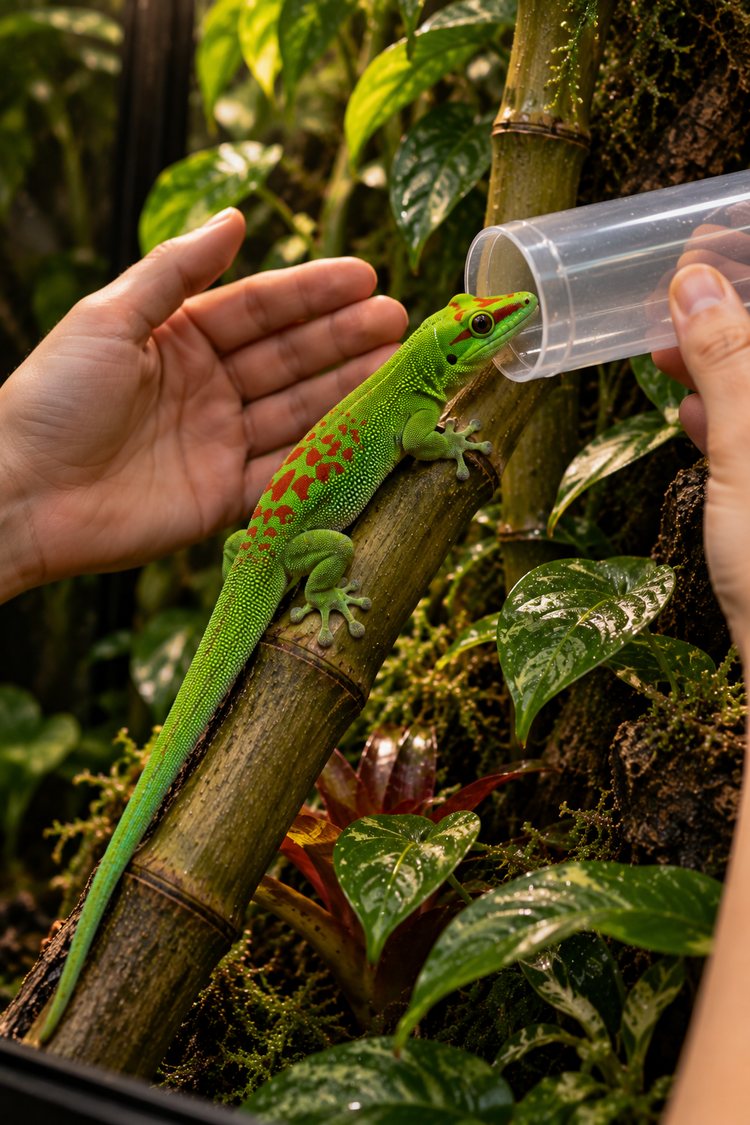
When relocation is necessary, guiding the gecko into a container or tube is generally safer than physically restraining it.
A new reptile should not immediately join an established reptile room without observation.
Keep new animals separately and monitor appetite, body condition, feces, hydration, skin and general behavior.
A reptile-experienced veterinarian can advise on fecal testing and other screening appropriate to the animal’s history.
Separate equipment between quarantine and established enclosures when possible.
This becomes increasingly important as a collection grows.
Health
Good husbandry prevents many of the problems encountered in captive Phelsuma, but it cannot prevent every disease.
Nutritional secondary hyperparathyroidism can develop when calcium metabolism is disrupted by poor diet, inadequate vitamin D3, insufficient UVB, unsuitable temperatures or a combination of these factors.
Possible signs include weakness, tremors, abnormal jaws, bent limbs, poor grip, spinal deformity and fractures.
Veterinary literature identifies nutritional secondary hyperparathyroidism as the most common metabolic bone disease in captive reptiles.
Visible skeletal changes require veterinary evaluation. Adding large amounts of calcium after deformities appear is not an adequate treatment plan.
Because day geckos actively climb toward light and heat, they can place themselves surprisingly close to lamps.
Unsafe fixture placement can cause burns. Excessive enclosure temperatures can also produce heat stress.
Monitor both basking surfaces and ambient temperature rather than assuming lamp wattage tells you how hot the enclosure is.
Insufficient access to water, excessive heat or inappropriate humidity can contribute to dehydration and retained shed.
Pay particular attention to toes. Retained skin can constrict digits and cause injury.
Repeated shedding problems deserve investigation rather than simply increasing misting indefinitely. Nutrition, health, enclosure airflow and temperature may also be involved.
The delicate skin that makes day geckos look almost velvet-like also makes physical restraint risky.
Skin loss can occur from rough handling, fighting or enclosure hazards.
Minor superficial injuries may heal, but extensive skin damage, continued bleeding, swelling or signs of infection require veterinary attention.
Cohabited day geckos may bite, chase or chronically exclude another animal from basking sites or food.
Not every problem begins with an obvious fight.
Weight loss, hiding, dark coloration, reduced basking or constant avoidance can indicate social stress. When in doubt, separate the animals.
Adult females may produce eggs even when a keeper did not intend to breed them.
Egg production increases demands for calcium and other nutrients. Females also need appropriate places to deposit eggs, depending on the species.
Persistent straining, marked lethargy, abdominal enlargement, weakness or suspected retained eggs warrants prompt veterinary evaluation.
Weight loss, persistent abnormal feces, poor appetite or declining condition can indicate parasites or other gastrointestinal disease.
A fecal examination can help determine whether parasites are involved.
Do not assume every loose stool is a parasite—or treat reptiles with antiparasitic medication without knowing what is present.
One of the advantages of keeping a daytime gecko is that you can observe a large portion of its normal behavior.
A healthy animal should regularly use the enclosure rather than remain permanently in one location.
Observe basking, climbing, hunting, feeding and resting patterns. Watch grip strength and movement. Record body weight periodically with a gram scale.
Also monitor feces, urates, shedding and changes in coloration.
Color alone is not a medical test. Day geckos can alter their appearance depending on light, temperature, stress and social context.
Look for patterns of change rather than one isolated observation.
Seek veterinary care for substantial weight loss, repeated refusal to eat accompanied by declining condition, persistent lethargy, abnormal breathing, swelling, discharge, severe retained shed, wounds, neurological signs, weakness, poor grip, suspected metabolic bone disease, reproductive difficulty or any rapid deterioration.
Reptiles often conceal disease until a problem has progressed.
When behavior and body condition change together, waiting for the animal to “look sick enough” can waste valuable time.
Do day geckos need UVB?
Appropriate UVB should be considered a normal part of modern day gecko husbandry. Phelsuma are diurnal basking geckos, and UVB supports natural vitamin D3 and calcium metabolism.
Do day geckos need a heat lamp?
Most commonly kept species need access to a warm basking area. The exact basking temperature depends on the species. Heat should create a gradient rather than warming the entire enclosure uniformly.
Can day geckos eat crested gecko diet?
A reputable nutritionally complete fruit-based gecko diet, like the staple diets in our crested gecko care guide, can be useful as the nectar/fruit component of captive Phelsuma nutrition. Day geckos should still receive a diet appropriate to their species, including live invertebrates.
Can day geckos eat fruit?
Many Phelsuma naturally consume fruit material and nectar. Fruit can be offered appropriately, but plain fruit should not replace a nutritionally balanced diet.
Can two day geckos live together?
It is possible with some species in carefully managed breeding situations, but individual housing is the safest default. Territorial aggression and reproductive pressure are real concerns.
Are day geckos good for handling?
Generally, no. They are best considered observation animals. Their skin is delicate, many species are very small, and they are exceptionally quick.
How humid should a day gecko enclosure be?
There is no universal percentage. Different Phelsuma species have different requirements. Most benefit from daily humidity variation rather than a permanently wet enclosure.
How long do day geckos live?
Lifespan varies by species, but many captive day geckos can live around 10–15 years or longer with good care. Madagascar Giant Day Geckos often reach about 15 years in zoological care, and some live even longer.
The most important lesson in day gecko care is also one of the simplest:
Know which day gecko you have.
A Giant Day Gecko, Gold Dust Day Gecko, Neon Day Gecko and Standing’s Day Gecko share the same genus and many biological characteristics, but they should not automatically receive identical husbandry.
Start with the animal’s natural history.
Then build an enclosure that provides usable height, bright daylight, UVB, safe basking, airflow, appropriate humidity, varied nutrition and enough cover for the gecko to choose where it wants to be.
A successful day gecko enclosure is not one that maintains a perfect number.
It is one that gives the animal the opportunity to behave like a day gecko.

 Ball Python Care: A Complete Guide to Healthy Husbandry