Panther Chameleon Care
The Complete Panther Chameleon Care Guide: Enclosure, UVB, Humidity, Diet and Health

The Complete Panther Chameleon Care Guide: Enclosure, UVB, Humidity, Diet and Health
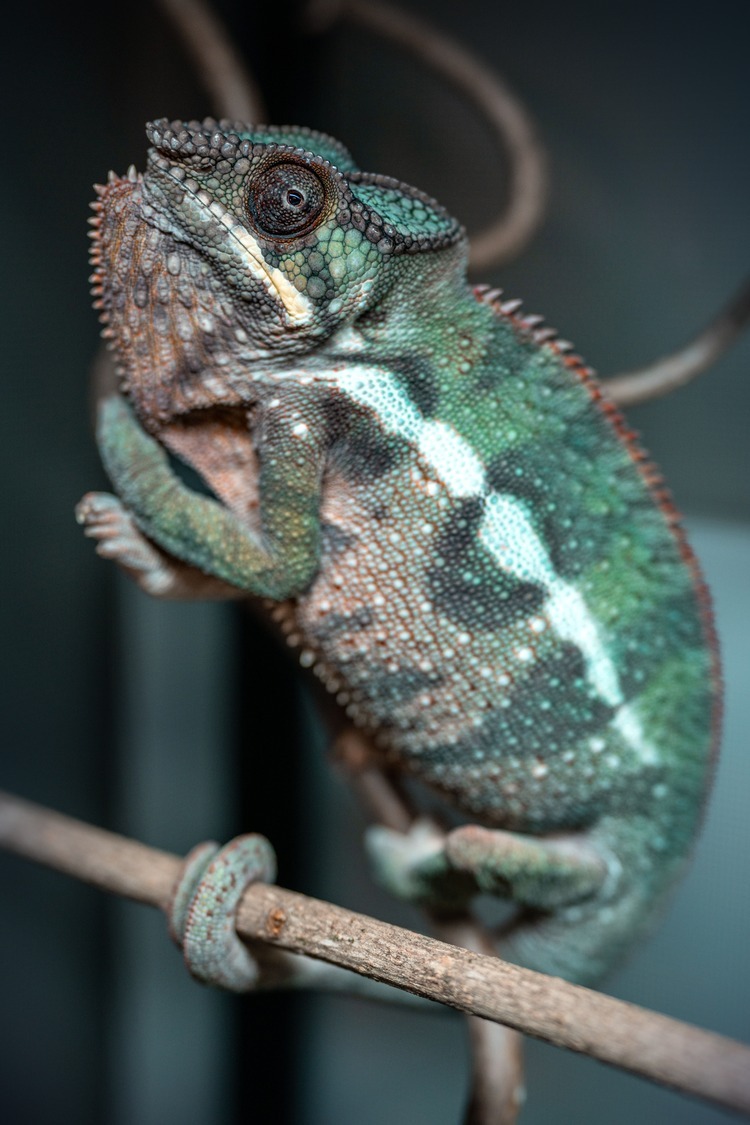
Few reptiles look as unreal as a panther chameleon.
Adult males can carry intense combinations of blue, green, red, orange, yellow, turquoise and white. Females are usually more restrained in color. Add independently moving eyes, grasping feet, a prehensile tail and a tongue that strikes prey from a distance. As a result, Furcifer pardalis is one of the most distinctive reptiles in the hobby.
That appearance can also create a problem. People buy the animal first and learn the husbandry afterward.
Panther chameleons are not forgiving of weak lighting, a poor hydration routine, chronic overfeeding, stale air or supplementation mistakes. They can do very well in captivity. However, the enclosure needs to work as an environmental system, not simply as a tall cage with a plant and a heat lamp.
This panther chameleon care guide focuses on that system.
The panther chameleon, Furcifer pardalis, comes from Madagascar. It lives in the coastal lowlands of the north, northwest and east of the island and on offshore islands such as Nosy Be. People have also introduced the species elsewhere, for example on Réunion, and Florida now has a feral population. It is an arboreal, daytime-active lizard of trees, shrubs, forest edges and other vegetated places, including gardens and plantations.
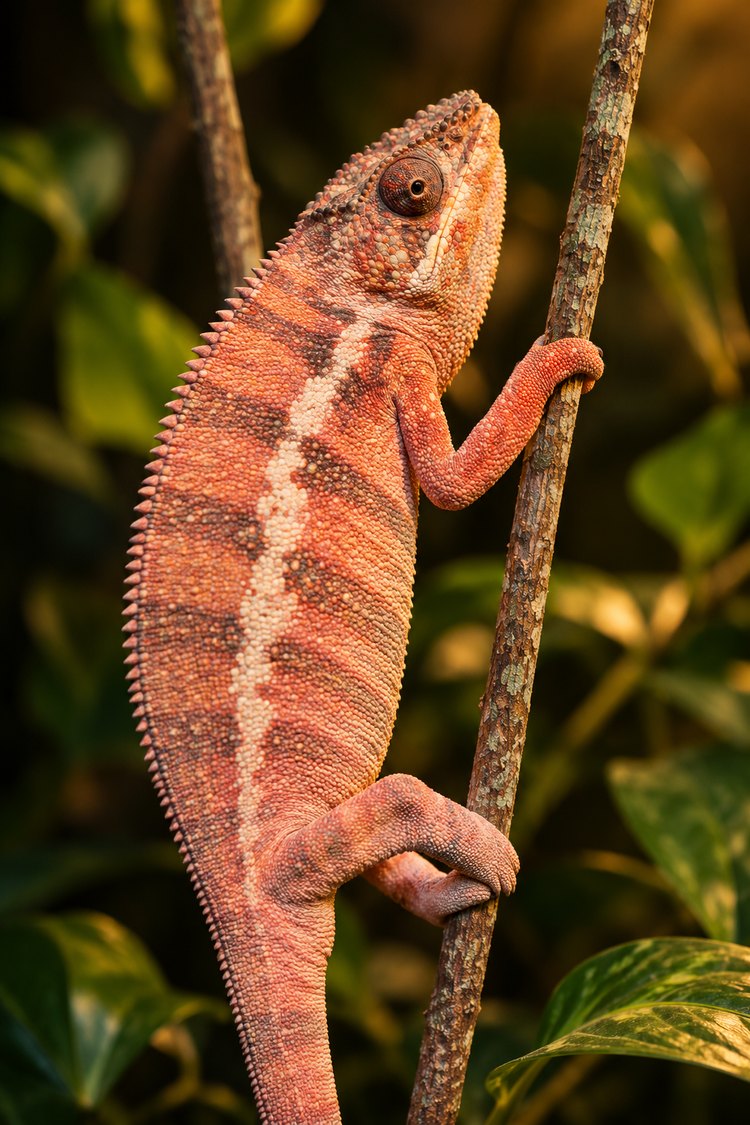
Adult males are far more colorful than females and reach roughly 16–20 inches (40–52 cm) in total length, depending on locale and individual. Females stay smaller, usually 10–14 inches (25–38 cm), and show a quieter range of peach, tan, orange and pink, with darker patterns when they are gravid or unreceptive.
Panther chameleons have bodies made for life in the branches. Their feet are zygodactyl, with the toes fused into two opposing bundles that grip like tongs. The prehensile tail works as a fifth limb, and unlike a gecko’s tail, the chameleon cannot drop it, and it does not grow back if lost. Each eye moves independently inside a scaly turret, so the animal can scan two directions at once and then lock both eyes on prey. The tongue can shoot out well beyond the body length in a fraction of a second.
Do not confuse the panther chameleon with the veiled chameleon (Chamaeleo calyptratus) from the Arabian Peninsula. The veiled chameleon carries a tall, helmet-like casque on its head; the panther’s casque is a low, rounded ridge, and males have a small raised ridge along the snout. The two species also come from different climates, so never apply a veiled chameleon care sheet to a panther. Jackson’s chameleons, with their three horns, are a third species again. Species-specific husbandry matters.
The important word here is arboreal. A panther chameleon does not need a tall enclosure because tall cages look natural. Its entire daily routine takes place through a three-dimensional network of branches and leaves. It climbs to warm up, moves into shade, chooses its own UV exposure, hunts from branches, drinks from wet leaves and retreats behind vegetation.
Good panther chameleon care therefore depends on giving the animal meaningful choices.
| Requirement | Practical starting point |
|---|---|
| Scientific name | Furcifer pardalis |
| Origin | Madagascar (north, northwest and east coasts, plus offshore islands) |
| Lifestyle | Diurnal, arboreal, mainly insectivorous |
| Adult size | Males about 16–20 in (40–52 cm), females about 10–14 in (25–38 cm) |
| Adult weight | Males roughly 200–220 g, females roughly 140–160 g |
| Lifespan in captivity | Males often 5–7 years, females often 2–5 years |
| Sexual maturity | About 6–9 months; breed females only after a year |
| Housing | One chameleon per enclosure |
| Adult enclosure | At least 24 × 24 × 48 in; larger preferred |
| Daytime ambient | About 72–78°F (22–26°C) |
| Basking area | Around 85°F (29°C) |
| Night temperature | About 60–70°F (16–21°C) |
| Day humidity | About 40–60% |
| Night humidity | About 80–100% with good airflow |
| UVB | Linear UVB; about UVI 3 at the basking branch |
| Lighting | Bright visible daylight plus UVB |
| Diet | Varied, properly gut-loaded feeder insects |
| Hydration | Misting, dew, nighttime humidity and an optional dripper |
| Handling | Limited, patient, preferably on the animal’s terms |
These numbers are not independent targets. Temperature, humidity, UVB, visible light, airflow, foliage and hydration all interact. Modern panther chameleon care treats them as parts of one daily cycle rather than as isolated settings.
Locales & Color
Names such as Ambilobe, Ambanja, Nosy Be, Sambava and Tamatave come up constantly in the panther chameleon hobby.
These are geographic locale names, not single-gene morphs in the way ball python or crested gecko breeders use the word “morph”. A locale describes where a line’s ancestors came from, and each population has its own typical male look. Ambilobe males have the widest range, famous for red or blue bars on a green, yellow or blue body. Ambanja males lean blue-green with blue-purple bars. Nosy Be males are often solid blue to seafoam green with red around the eyes. Sambava males rest in green and fire up into yellow, orange and red, and Tamatave males are mostly red.
That distinction matters. A large genetic study of more than 300 wild panther chameleons found strong geographic structure in their mitochondrial DNA and limited gene flow between populations. A computer model matched male coloration to those genetic groups well above chance, and the authors suggested that several of the 11 lineages, including island populations such as Nosy Be and Nosy Komba, might warrant species status. The authors made no formal split, however, and science still treats the panther chameleon as one species. In the same study, most of the pet-trade animals sampled did not match the locale on their sales label.
So an Ambilobe is not simply a chameleon that happens to look red and blue. Locale needs documented ancestry behind it. Captive breeding can also combine populations, and a cross may resemble one locale more than another. Appearance alone is therefore a poor substitute for pedigree. Females of every locale look much the same, so a female’s locale rests entirely on her records.
For keepers who want a companion animal, this does not change husbandry: care is identical across locales. For breeders, lineage records matter a great deal, and most of them discourage crossing locales.
The familiar explanation that chameleons change color to blend into the background is incomplete.
Color change serves several functions. In panther chameleons, research has shown that fast color change is part of social communication. Males shift color during contests and courtship by actively tuning a lattice of tiny guanine crystals inside skin cells called iridophores. Meanwhile, a deeper layer of the same cells reflects near-infrared light and probably helps the animal shed heat. An experiment with this species also found that females preferred males that showed a greater change in color saturation. Keepers know the female side well too: a receptive female stays pale, while a gravid or unreceptive female turns dark with strong orange or pink markings.
Color also changes with temperature, stress, social interaction, reproductive state and health. A dark, blotchy chameleon is often cold, frightened or unwell, not camouflaged. A bright displaying male is not showing his everyday resting colors either.
Color is communication as much as decoration.
Enclosure
For an adult panther chameleon, treat 24 × 24 × 48 inches as a practical minimum rather than an ideal. Larger enclosures give more room for gradients, foliage, movement and choice, and current specialist sources favor bigger enclosures whenever space allows; 36 × 24 × 48 inches is a common upgrade target.
Height matters because panther chameleons are arboreal. Width and depth matter too, because a narrow vertical tube does not create much usable territory.
The goal is to create several working zones:
The chameleon should be able to move between these areas without having to stay exposed. That freedom of choice is the heart of panther chameleon care.
One of the most persistent chameleon rules says that chameleons must live in screen cages. That is too simple.
Screen releases heat and humidity quickly, which helps in a naturally warm or humid room. In a dry, air-conditioned or heated home, the same cage loses its humidity almost immediately. Glass, PVC and hybrid enclosures hold humidity and stability far better, and they work very well as long as you design ventilation into them. A solid enclosure needs cross-ventilation, usually a low vent and a screen top, so warm wet air can move through it. Stale, saturated air is what causes respiratory infections, not humidity itself.
The right enclosure depends partly on the room around it. The objective is not to choose a material because the hobby traditionally prefers it. The objective is to produce the correct environment inside it.
House panther chameleons alone. Do not permanently keep two males, two females, a male with a female, or siblings together because they “grew up together”.
They are solitary animals, and forcing another chameleon into the same limited space removes the ability to create distance. Visual exposure matters as well. Two neighbors that can constantly see each other may live under lasting social pressure. Plants, opaque sides or careful placement can provide visual separation.
One chameleon, one territory. That remains the safest default.
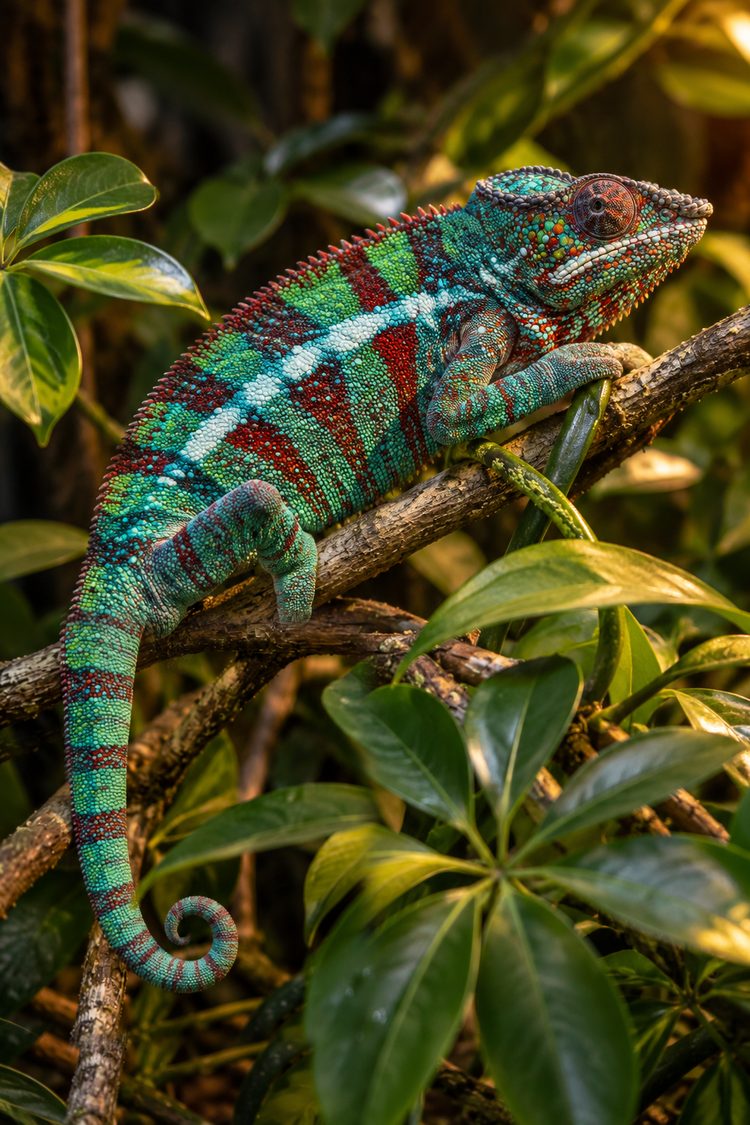
A panther chameleon enclosure should not be completely open. Nor should it hold so many plants that the animal cannot bask or hunt. A useful model is a forest edge: exposure and cover side by side.
Branches should create horizontal and diagonal routes throughout the enclosure, including routes beneath the basking area, through lit areas, behind foliage, into cooler areas and between feeding spots. Use branches of different thicknesses so the feet have something to grip at every size.
Live plants are especially useful because they create visual cover and drinking surfaces while adding structure. Pothos, Schefflera, Ficus benjamina and hibiscus are classic chameleon plants. Our guide to the best plants for reptile terrariums covers safe choices and how to prepare them.
The chameleon should have at least one retreat where most or all of its body is hidden from you and from the lights. That ability to disappear matters. An animal that has foliage on paper but stays visible from every direction does not have real cover.
Floor and water bowl. Panther chameleons do not recognize standing water, so a bowl is not a drinking source and can even drown feeder insects. Keep the floor bare or use a drainage layer instead of a soaked substrate, unless you are running a well-built bioactive setup. A clean floor is also easier to check for droppings and dropped feeders.
Panther chameleon care starts with warmth, but the animal does not need heat everywhere.
A useful modern starting point is a daytime ambient of about 72–78°F (22–26°C), a basking area of around 85°F (29°C), and a night drop to roughly 60–70°F (16–21°C). A meaningful nighttime drop is normal for this species. Hatchlings and young juveniles overheat and dehydrate faster, so keep their basking spot gentler, raise the lamp a little and watch them closely.
Older care sheets often recommended hotter basking spots. Current husbandry has moved toward more moderate temperatures, partly because captive animals cannot escape heat as freely as wild ones.
The basking area should let the animal warm up and then leave. Do not heat the whole enclosure to basking temperature, because that destroys the thermal gradient. Use a plain incandescent or halogen basking bulb raised above the screen, never resting on the mesh and never inside the cage. Chameleons climb the screen under a lamp and burn their back spines and casque. Heat rocks and heat mats are useless for an arboreal lizard. At night, give the animal 12 hours of real darkness. A normal home needs no heat and no colored “night” bulbs, because the cool drop is part of the cycle. Only if the room falls well below 60°F should a non-light heat source such as a ceramic heat emitter run on a thermostat.
Do not measure only the top screen or the room. What matters is the temperature where the animal’s body actually sits.
Measure the basking branch, the upper ambient area, the middle of the enclosure and the lower cool area. A digital probe thermometer and an infrared thermometer do different parts of this job well.
Your chameleon should be able to choose. That principle appears throughout good reptile husbandry.
Light & UVB
Few commonly kept reptiles have such useful species-specific research on UVB as the panther chameleon. That research shapes modern panther chameleon care.
Experiments have shown that panther chameleons adjust their UV exposure according to how much vitamin D3 is in their diet. Animals that received less dietary D3 chose to spend more time under UVB. Research on captive breeding has also linked UVB exposure to vitamin D physiology and reproduction. Specifically, females kept under irradiance closer to their natural high-UV environment produced eggs with more vitamin D3 and better hatching results.
That makes one thing hard to justify: treating UVB as optional because dietary D3 exists. These animals evolved with the ability to regulate their own exposure. Give them that option.
A practical captive target used today is about UVI 3 at the basking branch. This is a husbandry target, not a claim that the species experiences exactly UVI 3 everywhere in nature. Field and experimental work shows that panther chameleons use fairly strong UV environments and can choose their dose.
Use a linear T5 high-output UVB tube with a reflector, not a small compact bulb asked to light the whole enclosure. With a 6% (5.0) tube, the basking branch usually sits about 6 inches below the screen; a 12% (10.0) tube needs more distance. Replace the tube on the maker’s schedule, usually every 12 months, because UV output fades long before the lamp stops glowing.
Most importantly, measure the result when possible. Bulb percentage alone tells you very little, because the UV that reaches the animal depends on lamp output, reflector, mesh, distance, lamp age and fixture design. A UV index meter removes most of that guesswork. Check the basking branch weekly after a new setup, then monthly.
Providing UVB does not mean exposing the whole enclosure evenly. A panther chameleon should be able to move into UVB and out of it. Dense foliage beneath part of the lighting creates that choice.
A correct UVB lamp can still produce a visually dim enclosure. Panther chameleons are daytime animals from bright outdoor habitats.
A good setup therefore has three separate lighting jobs: visible daylight that makes the cage bright, UVB that provides ultraviolet, and basking heat that provides warmth. Do not expect one lamp to do all three well. Use strong, broad visible light, such as a 6500K LED bar, across most of the enclosure while keeping shaded retreats. Run all lights on a timer for a 12-hour day.
A chameleon enclosure should look like daytime.
One of the biggest improvements in modern panther chameleon care has been moving away from the idea that tropical means wet all day.
Panther chameleons naturally live through a daily humidity cycle. A practical baseline is about 40–60% relative humidity by day and 80–100% at night. The percentages alone do not tell the whole story.
During the day, the enclosure should warm up, air humidity should fall and branches and leaves should dry. At night, the temperature drops and humidity rises a lot. High nighttime humidity needs air movement alongside it, not stagnant, saturated air. That distinction is critical. High humidity does not mean permanently wet.
Hydration should resemble the way an arboreal chameleon meets water in the wild: droplets on leaves and surfaces, not a bowl of standing water.
A practical cycle can include:
Specialist protocols place fogging in the coolest part of the night, typically the hours before dawn, never during the warm day. The exact schedule depends on how fast your enclosure dries. A screen cage in a dry room and a hybrid cage in a humid room should not run the same timer settings. Measure the enclosure instead of copying numbers.
A well-hydrated chameleon has round, full eye turrets and mostly white urates; a small orange portion can be normal. It also tends to ignore the dripper. Sunken eyes, mostly orange or chalky urates and an animal that rushes to drink at every misting mean the hydration routine needs work.
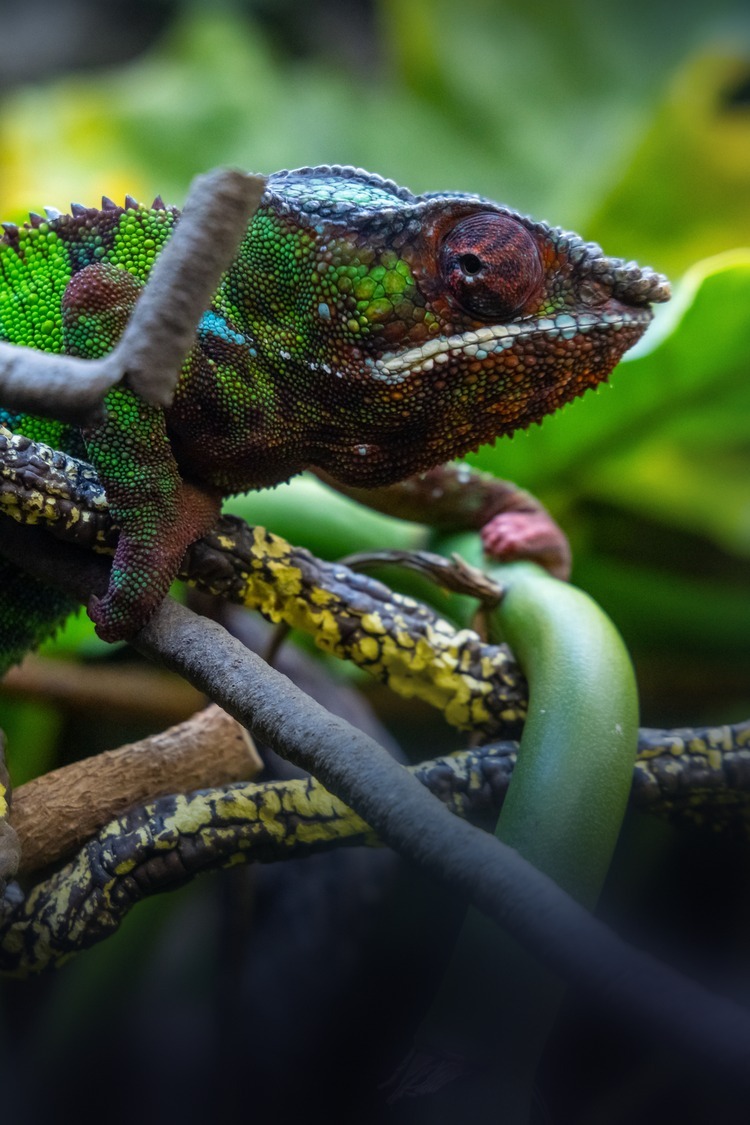
Once an automatic misting system enters the picture, so does water management. Repeated misting sends a surprising amount of water through a tall enclosure.
Plan drainage before the chameleon moves in. Standing dirty water under the enclosure is not a hydration strategy. Many traditional setups therefore use a clean floor with a drainage tray rather than a permanently soaked substrate. A planted or bioactive floor can also work, but only if you manage the excess water properly.
Diet & Supplements
Panther chameleons are mainly insectivorous. The foundation of the captive diet is a variety of appropriately sized feeder insects.
Useful feeders include crickets, dubia and other roaches, black soldier fly larvae and adults, blue bottle flies, silkworms and hornworms with their moths. Locusts where legal, mantis hatchlings, stick insects and captive-bred snails add further variety. Waxworms and superworms are fatty and belong in the treat category. Size the feeder to the animal: no longer than the distance between the chameleon’s eyes is a safe rule.
In panther chameleon care, variety beats building the whole diet around one species.
A feeder insect is not simply a delivery vehicle with legs. Its nutritional value depends on what it has been eating.
Gut-loading feeders before offering them is therefore a core part of panther chameleon nutrition. Current guidance recommends gut-loading for about 24–48 hours before feeding, on fresh vegetables, greens and a quality dry gut-load. Your supplement routine cannot fully compensate for poorly kept insects. Nutrition starts before the insect reaches the enclosure.
Young panther chameleons grow fast and usually eat daily, as much as they will eat in a short session. Hatchlings should have food available almost constantly, starting with fruit flies and moving up to week-old crickets, and a weekly weigh-in tells you whether a baby is growing. Adults need far less.
A practical adult starting point used by current specialist keepers is roughly 3–5 appropriately sized feeders every other day, adjusted for body condition, feeder type, sex and reproductive status. Gravid females eat daily. If fat pads build up behind the head, cut back.
Do not confuse appetite with need. Panther chameleons keep eating past what is good for long-term body condition. That matters most with females.
Insects alone do not provide the mineral and vitamin balance a captive chameleon needs. Supplementation is therefore a necessary part of panther chameleon care.
However, chameleons are not animals where adding more calcium, vitamin D3 and vitamin A is automatically safer. Over-supplementation, especially of D3 and preformed vitamin A, is a real cause of illness in captive chameleons, and veterinary references describe this species as relatively sensitive to excess vitamin A. D3 and vitamin A also work against each other, which is one more reason to keep both moderate.
Plan supplementation together with UVB exposure, feeder nutrition, supplement concentration and feeding frequency. One widely used modern framework, with UVB at about UVI 3, is plain calcium without D3 at routine feedings and a multivitamin with low D3 and vitamin A about twice a month. Another approach, printed on the label of some low-D3 all-in-one products, is that single product at every feeding. Both work; mixing them does not.
Different products contain very different concentrations. Do not copy the frequency of one supplement and apply it to another. The dose belongs to the product and the husbandry system, not simply to the words “calcium” or “multivitamin”.
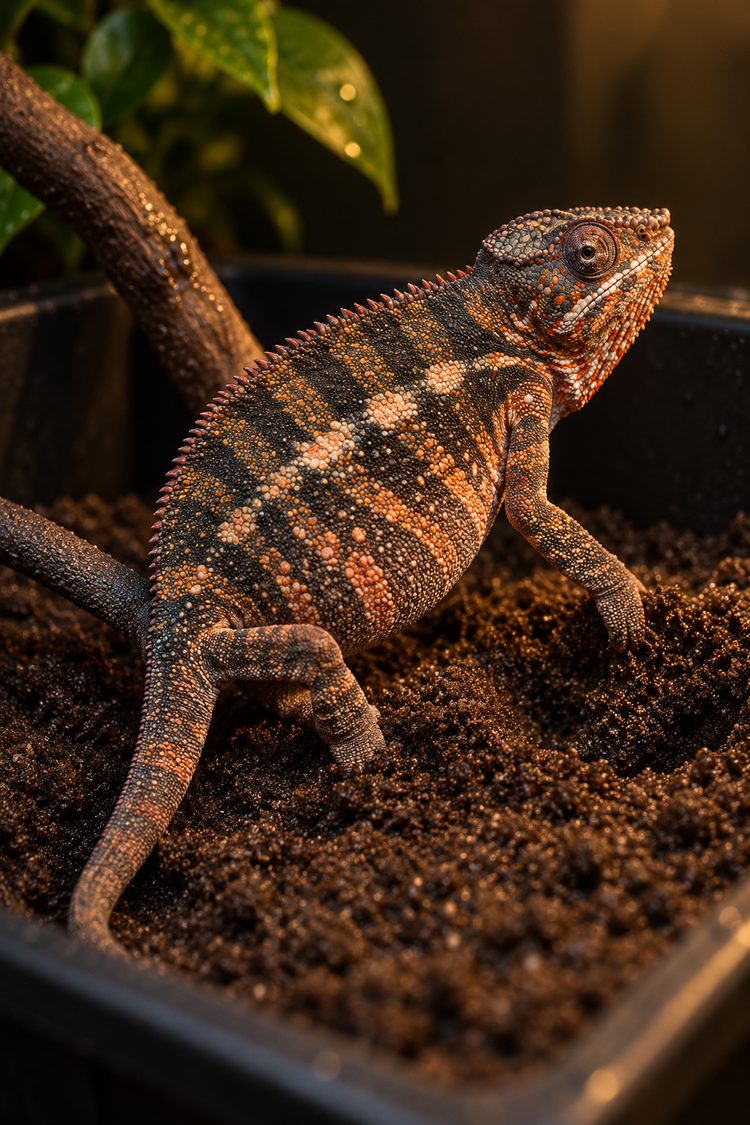
Female panther chameleon care deserves its own section, because reproduction creates husbandry demands even when breeding is not the goal.
Panther chameleons lay eggs. Females can develop eggs without ever meeting a male, so a female showing reproductive behavior must have access to a suitable laying site. Signs include restlessness, pacing the floor, digging, refusing food and darker coloring.
Current specialist guidance favors a laying bin with about 4–5 inches of moist, diggable substrate that holds a tunnel without collapsing, such as a half-and-half mix of washed play sand and organic soil. Older advice called for 10–12 inches, but deep bins tire the female and the tunnels tend to collapse. Privacy is critical while the female searches and digs. Do not repeatedly disturb a female that is trying to lay; a female with constant interruptions can abandon the clutch and become egg-bound.
A typical clutch is roughly 10–40 eggs, often around 20, laid about a month after mating. A mated female can store sperm and produce a second fertile clutch later. Fertile eggs incubate for roughly 7–12 months at cool room temperature, pausing development for part of that time. Egg laying is the most dangerous part of a female’s year, so expect to offer the bin for weeks at a time and keep her well hydrated. After laying, let her eat freely for a week or two to recover.
Overfeeding adult female chameleons is not simply a cosmetic obesity problem.
Excessive food intake can drive larger clutches and heavier fat deposits. Experienced breeders warn that oversized clutches and internal fat make laying harder, and veterinary references list obesity and reproductive disease among the significant problems of captive chameleons. Keeping an adult female slightly cooler and on a modest, every-other-day diet reduces clutch size and extends her life.
This is one reason adults need controlled feeding rather than unlimited food. Reproductive husbandry matters even for a female that never breeds.
Panther chameleons are, first of all, animals to watch.
Some individuals become very comfortable around their keepers. Others stay defensive for life, and a defensive chameleon flashes its brightest warning colors, flattens its body sideways, puffs out its throat, gapes, raises a front leg and may bite. Do not measure success by whether the chameleon enjoys handling.
Forced handling, especially grabbing from above or pulling the animal off a branch, removes choice and causes stress. Hands that come from above read as a predator. The grip of the feet and tail is strong enough that pulling can injure toes or break bones, so never peel a chameleon off its perch.
A better approach is gradual. Give a new arrival one or two quiet weeks to settle before any interaction. Then let the chameleon get used to your presence, associate you with feeding, step onto an offered branch or hand, and climb out on its own when possible. Slow, predictable interaction is better than repeated forced handling, and wash your hands afterward, as with any reptile.
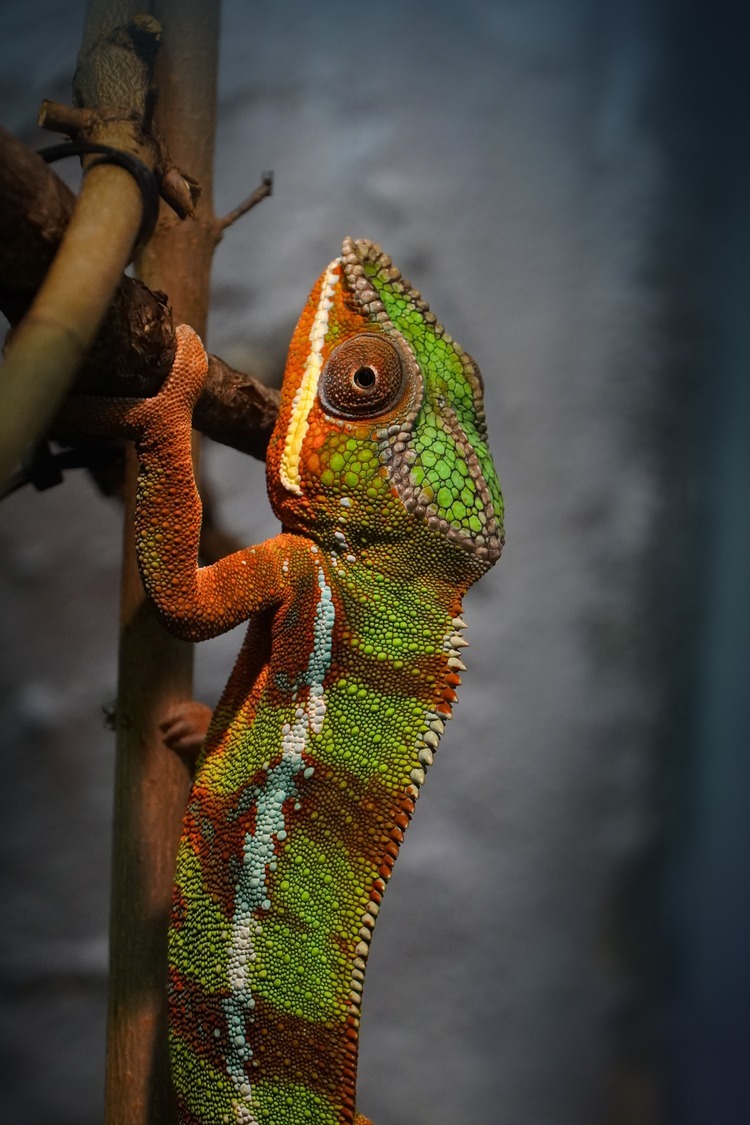
Captive panther chameleons develop a recognizable set of problems, and most trace back to gaps in panther chameleon care:
Veterinary references name metabolic bone disease, reproductive problems, eye disease and parasites among the conditions seen most often. That is why you should not judge an enclosure simply by whether the animal is alive and eating. Look at the whole system.
Panther chameleons shed in pieces rather than in one skin, and a healthy shed usually finishes within hours. Do not lower the humidity for it, and do not pull at loose skin. Check the toes and the tail tip afterward, because a retained ring of old skin there can tighten like a tourniquet. A moist cotton swab loosens most of it; anything stubborn or repeated belongs with the vet.
Read changes in a panther chameleon in context, but never ignore real warning signs. Be concerned when an animal:
A reptile-experienced veterinarian should evaluate suspected illness. Changing supplements or increasing misting without understanding the problem is not a substitute for a diagnosis.
For most keepers, a well-started captive-bred panther chameleon is the better choice.
Captive-bred animals come with more reliable information about age, origin, parentage, locale, previous husbandry and feeding history. Wild-caught reptiles carry a greater risk of parasites and suffer the effects of capture, transport and a sudden change of environment.
When you pick an animal, watch it walk along a thin stick: the grip should be firm and the gait confident. Look for round, full eye turrets that track movement, straight limbs and jaw, and no swelling of the gums. Also check for a straight tail that grips, no grey patches on the back, clean vents and clear nostrils. A chameleon sitting low with closed eyes, dark colors or a soft jaw should stay at the shop. The same goes for one from a crowded display cage or a seller who will not discuss lineage. Quarantine every new arrival in its own enclosure, ideally in a separate room, for at least 60–90 days. During that time, have at least two fecal samples checked for parasites a few weeks apart.
You can sex young panther chameleons from about 3–4 months of age. Males develop a hemipenal bulge at the base of the tail, obvious by 6–8 months, and a more pronounced ridge along the snout. Females stay smaller and plainer, with a slight dip behind the vent. Color is unreliable before about 5–7 months. Both sexes mature at roughly 6–9 months, although a female needs to be a year old before breeding.
For a breeding project, documented parentage becomes even more important, because geographic locale is part of the animal’s lineage, not merely a color description.
These are the panther chameleon care mistakes we see most often.
High nighttime humidity does not justify permanently wet branches and leaves. Let the enclosure dry during the day.
A strong UVB lamp too far away gives very little UV. The same lamp too close gives too much. Distance and mesh matter.
UVB and bright daylight do different jobs. A dim cage with a UVB tube is still a dim cage.
The animal needs a gradient, not one uniform temperature.
Ventilation does not replace foliage. The animal needs privacy and visual cover.
Seeing no fight does not prove two chameleons are comfortable sharing a small territory.
Growth feeding should not continue forever. Adult intake should match adult energy needs and body condition.
A female may need a laying site even if she has never met a male.
Panther chameleon care starts before the animal arrives: have the enclosure running and measured for a week. A complete setup for one adult usually includes:
Timers for the lights, mister and fogger turn this list into the daily cycle. You will find the lighting, supplements and feeder supplies in our reptile supplies.
They are not the reptile we would choose for someone who wants the easiest first enclosure.
Panther chameleon care requires coordination between heat, UVB, visible light, nighttime humidity, daytime drying, misting, ventilation, feeder nutrition, supplementation and drainage. None of those pieces is very difficult on its own. The challenge is making them work together.
For a keeper prepared to measure conditions, automate hydration where useful, keep feeder insects well and watch behavior closely, panther chameleons are extremely rewarding. For someone who wants an animal that tolerates broad husbandry errors, there are easier choices.
How big does a panther chameleon get?
Adult males are among the larger commonly kept chameleons and reach roughly 16–20 inches (40–52 cm) in total length. Females are generally smaller, around 10–14 inches (25–38 cm).
How long do panther chameleons live?
With good care, males often live 5–7 years in captivity, sometimes longer. Females usually live shorter lives, often 2–5 years, because egg production takes a heavy toll. An unbred female, however, can live as long as a male.
What size enclosure does a panther chameleon need?
In panther chameleon care, a practical minimum for one adult is about 24 × 24 × 48 inches, with larger enclosures preferred whenever possible.
Can two panther chameleons live together?
No. House them alone. Even male-female or female-female pairs do not belong together permanently.
Do panther chameleons need UVB?
Yes. UVB is a core part of modern panther chameleon care, and researchers have studied this very species for UVB-driven vitamin D3 regulation.
What temperature should a panther chameleon bask at?
Around 85°F is a useful modern starting point, with daytime ambient temperatures in the 70s and cooler conditions at night.
What humidity does a panther chameleon need?
Think in cycles rather than one constant number. About 40–60% by day and 80–100% at night works well, provided airflow stays good and surfaces dry during the day.
Do female panther chameleons lay eggs without mating?
Yes. They can develop infertile eggs, so every female keeper needs to understand laying behavior and provide a laying bin even with no breeding planned.
Successful panther chameleon care is less about finding one perfect humidity number or one perfect lamp. Instead, it is about creating a daily rhythm: a cool, humid night, morning moisture, bright daylight, a warm basking spot and strong but escapable UVB. Then a drier daytime, dense foliage beside open hunting space, well-fed insects rather than empty feeders dusted in powder, and enough room for the chameleon to decide where it wants to be.
When those pieces work together, the enclosure starts giving the animal choices. That is a much stronger foundation for husbandry than trying to hold every number constant.
