Lilly White Crested Gecko
Genetics, Identification and Responsible Breeding of the Lilly White Crested Gecko

Genetics, Identification and Responsible Breeding of the Lilly White Crested Gecko
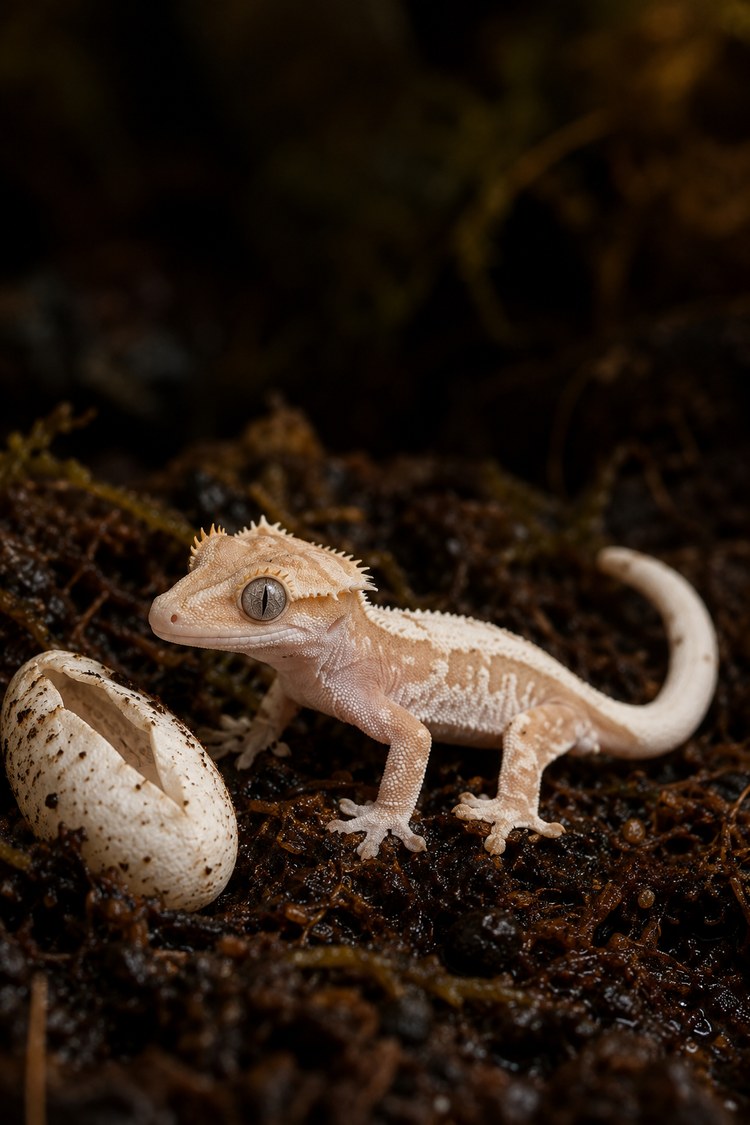
Few morphs have shaped modern crested gecko breeding as much as the Lilly White crested gecko.
At first glance, the appeal is obvious. White and cream can spread across the back, sides, belly, limbs and tail. Over a deep red, orange, yellow, lavender or almost black base, that pale coverage creates contrast that classic harlequins rarely reach.
However, Lilly White matters for more than its looks. Many crested gecko colors and patterns come from years of selective breeding. Lilly White, by contrast, follows a repeatable inheritance pattern. One copy produces the visible morph, while two copies produce a form that does not survive.
As a result, Lilly White is both a powerful breeding tool and a morph that nobody should pair without understanding its genetics. This guide covers the Lilly White crested gecko only. For the general rules of inheritance, see our Crested Gecko Morphs & Genetics guide.
The accepted history begins in the United Kingdom. In late 2010, Nick Lumb of Lilly Exotics hatched an unusually pale, cream-and-white crested gecko. It looked different enough from its clutch mates that he kept it for his own project.
When the gecko was bred, some of its offspring showed the same unusual look. That result was the key point. The pale appearance was not just one exceptional high-white animal. Instead, something heritable was passing from parent to offspring.
Breeders named the project Lilly White after Lilly Exotics. Over the following years, the trait spread from that UK project into collections around the world.
The spelling matters, too. The established name is Lilly White, with two Ls, because of its link to Lilly Exotics.
| Characteristic | Lilly White |
|---|---|
| Species | Correlophus ciliatus |
| Trait type | Incomplete dominant (proven by breeding results) |
| One copy | Visual Lilly White |
| Two copies | “Super Lilly White”, not viable |
| Recommended pairing | Lilly White × non-Lilly White |
| Expected Lilly offspring | About 50% per egg from Lilly × non-Lilly |
| Hidden carrier | No conventional “het Lilly White” |
| Typical look | Wide white or cream coverage over a variable base color |
| Special care | None established for one-copy Lilly Whites |
| Causal mutation known? | Not yet identified in published research |
Breeders know the inheritance pattern well. Still, scientists have not yet identified the exact DNA change behind Lilly White.
It is tempting to say Lilly White simply “adds white”. In reality, the effect is more complex.
An ordinary Lilly White keeps plenty of pigment. Red, orange, yellow, brown, lavender, grey or black can all stay clearly visible. Instead, the morph changes how pale pattern spreads across the body. The result is often broad cream-to-white coverage with unusually sharp edges between pale and dark areas.
This effect can reach the dorsal, the upper and lower laterals, the belly, the limbs, the tail and parts of the head. Moreover, the amount varies a great deal. Some Lilly Whites keep large windows of base color, while others approach very high coverage. Some look brilliant white, and others look warmer, more cream or yellow.
That is why Lilly White is a genetic label, not a quality grade. Two geckos can carry the same trait and still look completely different. Breeders also report that Lilly White can make some base colors look more intense. Nobody has explained that effect at the molecular level yet.
No, it is not. A Lilly White keeps a lot of dark and colored pigment. In addition, its eyes are not the red or pink eyes seen in many albino reptiles.
Breeders sometimes call Lilly White a leucistic-type trait. That label reflects the strong loss of pigment in parts of the body and the almost all-white two-copy form. However, it is a description, not a diagnosis. We still do not know the exact pigment pathway or mutation involved.
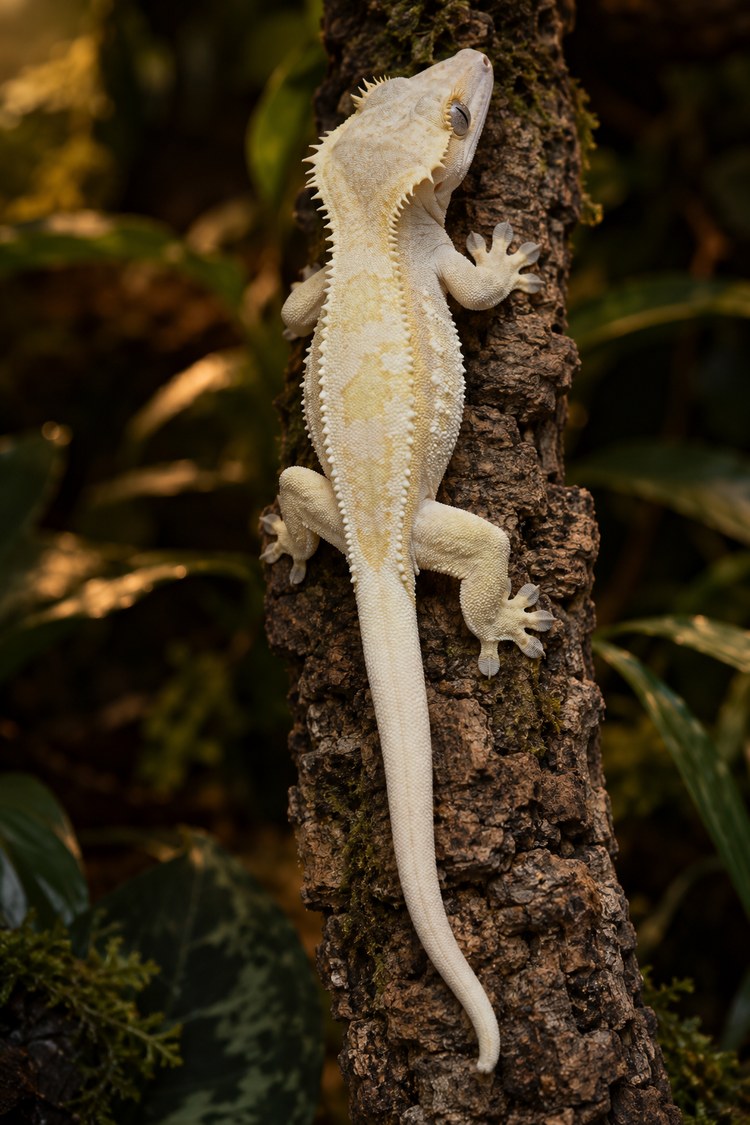
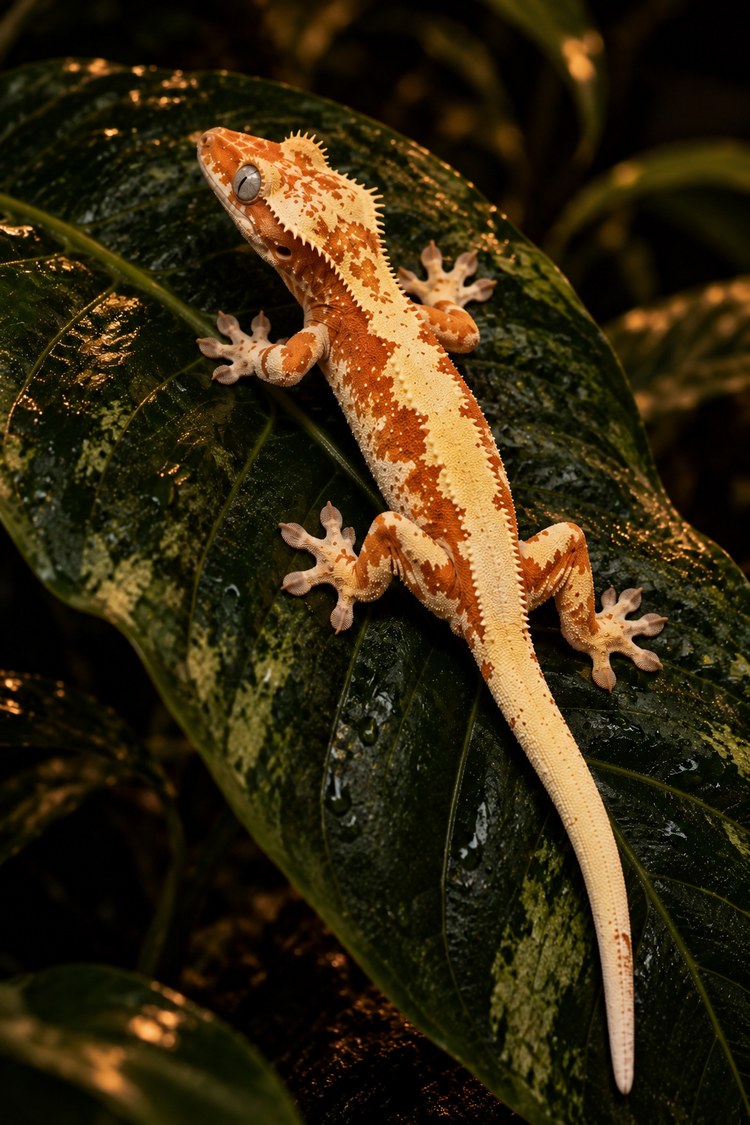
One fascinating feature of Lilly White is how much the look develops after hatching.
A hatchling may show pale cream, yellowish or even warm orange areas. Over time, these areas often become lighter. The lateral coverage may appear to climb higher, the dorsal may brighten, and the contrast with the base color can become much stronger.
For this reason, you should not judge a young Lilly White as a miniature copy of its adult self. Photos taken at hatching, as a juvenile and as an adult show how a particular line matures. For a breeding project, that photo record is far more useful than one adult picture.
Identification
Long-term Lilly White breeders describe several recurring signs:
These signs are useful clues. Nevertheless, they are not a genetic test. The raised scales are not true spines, and pinstripe geckos also have raised pale scales. Likewise, a Phantom or low-expression Lilly White can keep a darker, more patterned head.
Lilly Whites are also not always bright, high-contrast animals. Many show soft cream, tan, olive or pale yellow tones with gentle contrast.
Today, visual identification is harder than it was in the early years. Very high-expression harlequins, Whitewall projects and white-spotted lines can all look similar at first glance. Other genes can also change how Lilly White itself appears. So, for a breeding animal, documented parentage is more reliable than a photograph.
A heavily patterned harlequin can carry a lot of cream or white without any Lilly White. Usually, harlequin pattern follows familiar dorsal, lateral and limb structures. Lilly White, on the other hand, often spreads a broader pale overlay that ignores those boundaries.
Even so, extreme animals of both types can overlap. “It looks white enough” is therefore not proof of Lilly White genetics.
Whitewall and Lilly White are also different traits. Whitewall mainly creates a solid band of pale color along the lower sides. Lilly White usually affects much more of the body, often including the dorsal, belly, tail and limbs.
Again, combination animals can blur the picture. When breeding value depends on genetics, lineage should settle the question.
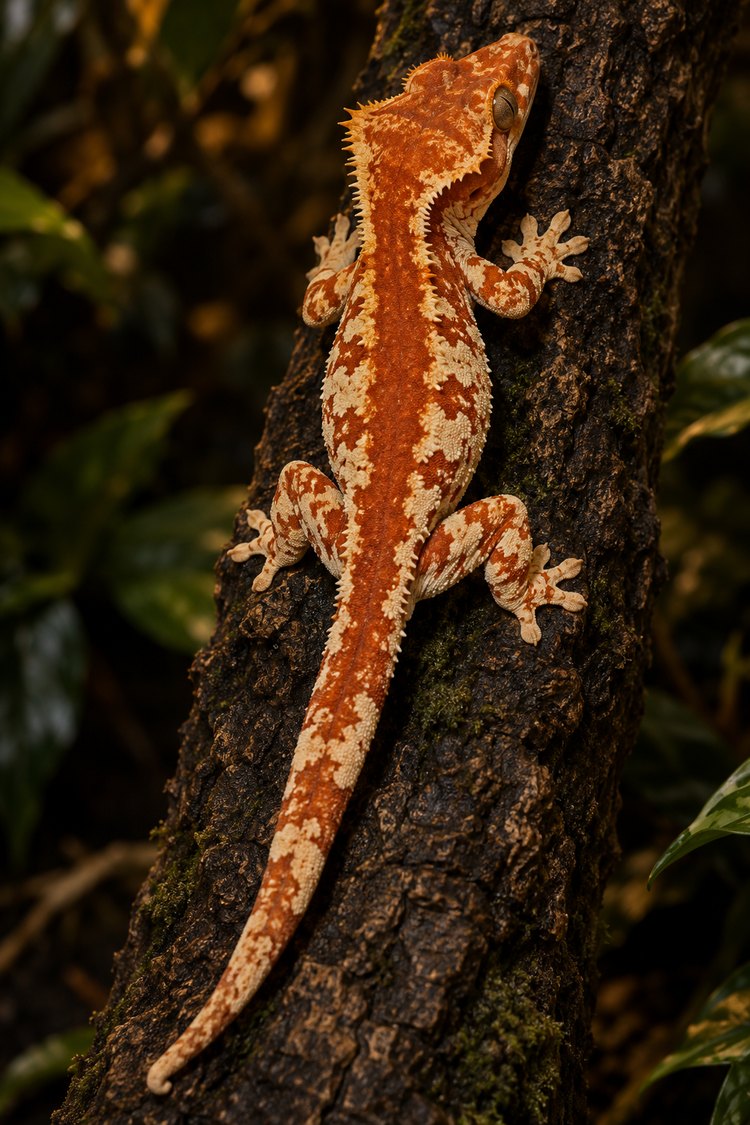
Not every Lilly White is covered in white. A low-expression animal may keep much more base color and pattern. Yet it carries the same single copy as a very high-coverage Lilly White.
This matters when you buy or sell. Expression and genetic status are separate things. A low-expression Lilly White is not “less Lilly White”. Likewise, a very white non-Lilly gecko does not become a Lilly White because of its looks.
Genetics
Our main genetics guide already explains how inheritance works, so this section focuses on Lilly White alone.
For this morph, the practical model is simple. A living Lilly White carries one copy of the Lilly White variant and one non-Lilly copy at the same location. That one-copy state is always visible.
For each egg, the expected odds are:
| Possible offspring | Probability |
|---|---|
| Lilly White | 50% |
| Non-Lilly White | 50% |
Keep in mind that this is a probability for each egg. Ten hatchlings do not have to include exactly five Lilly Whites. A single clutch can land well above or below 50%. Across many clutches, though, results should move toward the expected ratio. You can test pairings like this with our Morph Calculator.
This term causes needless confusion. Technically, every ordinary Lilly White is heterozygous, because it carries one copy. However, reptile keepers usually use “het” for a normal-looking animal that secretly carries a recessive gene.
That idea does not apply here. An animal that inherits the Lilly White copy shows it. An offspring that does not inherit it is simply non-Lilly at that location. “100% het Lilly White” is therefore a misleading description.
Instead, breeders can call such an animal a non-Lilly sibling. That label records its family link to the project without suggesting it carries Lilly White.
This is the defining welfare issue of the morph. When two Lilly Whites are paired, the expected odds at conception are:
| Genetic outcome | Expected probability |
|---|---|
| Non-Lilly | 25% |
| Single-copy Lilly White | 50% |
| Two-copy Lilly White | 25% |
Breeders call the two-copy form Super Lilly White. Despite the name, it is not a premium high-white version.
Super Lilly White is lethal. Breeder records show that the all-white, two-copy form does not survive. Most die in the egg. The few that hatch survive only a very short time. No breeding goal justifies pairing two Lilly Whites.
There is a further point that is easy to miss. The 25/50/25 split describes odds at conception. Because the two-copy class dies, it may vanish from the hatchling count entirely.
Among the surviving classes, the ratio shifts toward roughly two Lilly Whites for every non-Lilly. At first glance, Lilly × Lilly might therefore look like an efficient way to produce Lilly Whites. In fact, about a quarter of the eggs were placed into a lethal class. Counting only the survivors hides that cost.
Breeder evidence clearly shows that the two-copy form is not viable. The cause, however, is less certain. Some breeders suggest that such extreme pigment disruption may interfere with normal development, perhaps through melanin in internal tissues.
So far, that remains a hypothesis. No published study has identified the Lilly White mutation or shown why the two-copy state fails. In short, we know the breeding outcome far better than its molecular cause.
Combinations
Once the safe genetics are clear, the creative part of a Lilly White project begins.
A Lilly White should normally be paired with a non-Lilly gecko. As a result, the non-Lilly partner matters enormously. Breeders choose that partner for structure, a darker base, cleaner reds, intense yellows, desirable pattern, better crests, unrelated ancestry or other compatible traits.
The Lilly White variant is only one part of each offspring. An average breeding animal does not become exceptional just because it carries Lilly White.
The contrast that Lilly White creates depends on the color left around the pale areas:
This is one reason the morph stays interesting, even though it is now common. The inheritance is predictable, but the visual result varies endlessly.
Lilly White does not act alone. The same gecko may also carry harlequin-type pattern, pinstripe, tiger, white pattern, spotting, Phantom and other influences. Lilly White can cover or alter how some of these appear.
Consequently, what you see on a Lilly White is not always everything it carries. The non-Lilly siblings from the same pairing often reveal the background pattern that both parents pass on.
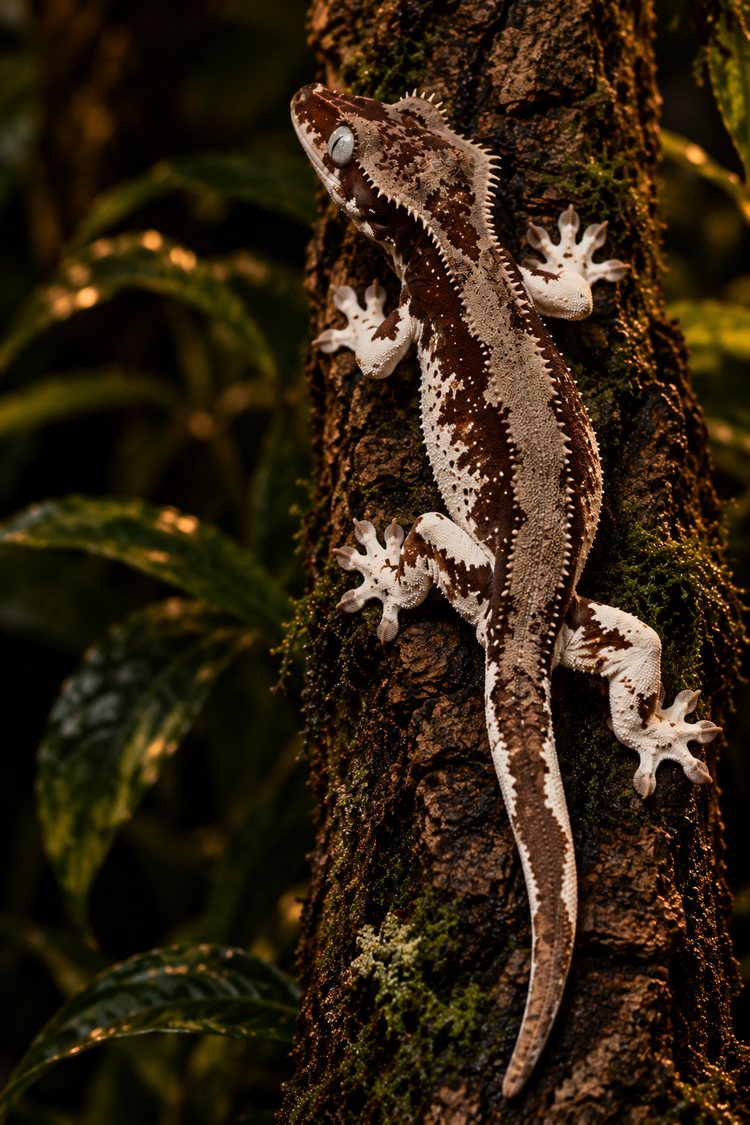
This is one of the clearest examples of a trait that reshapes Lilly White. The Phantom trait suppresses much of the usual pale pattern. In a Phantom Lilly White, it can therefore tone down the bright white dorsal while pale areas remain elsewhere.
The result can look surprisingly dark. This combination shows why the amount of white alone is not a safe way to identify Lilly White.
Breeders report that Lilly White tends to suppress Dalmatian spots inside its pale pattern. Spots can still appear where darker pigment remains, for example where Phantom brings color back.
This fits a working pigment hypothesis, but nobody has tested the mechanism yet. Therefore, record Dalmatian ancestry even when a Lilly White offspring shows fewer spots than expected.
Modern breeders have pushed Lilly White coverage far beyond many early animals. That progress does not mean the variant itself became stronger. Instead, selective breeding can stack background traits that increase pale pattern.
For example, breeders report that combining Lilly White with white-spotted lines can produce animals with extremely high white coverage. A top high-coverage Lilly White may therefore reflect years of selection beyond the Lilly White variant itself.
A gecko with one copy of Lilly White and one copy of Cappuccino is called a Frappuccino. Frappuccinos can look very different from either trait alone, often with strong head markings, deep color and unusual contrast.
However, a Frappuccino is not a Sorak. A Frappuccino combines ordinary Cappuccino with Lilly White. A Sorak, by contrast, combines the two-copy Super Cappuccino form with Lilly White. We will cover Cappuccino and Frappuccino in their own articles.
This is where older Lilly White articles may now be out of date. In September 2026, a collaborative breeder project (Foundation Genetics) updated its Super Cappuccino warning.
It reports that Super Cappuccino, Sorak, Luwak and Cappuccino/Highway combinations are usually lethal within about 24 months, and many die sooner. Reduced nostril openings appear in many of these animals, Sorak included. The same update states that ordinary Cappuccino and Frappuccino animals are not affected by this nostril problem.
So, base every pairing on current welfare information, not on an old morph chart. Breeders should never aim to produce Soraks.
Lilly White can also be combined with recessive projects such as Axanthic. Because Axanthic is recessive, breeders must first track the hidden allele through the pedigree. Only then can they produce visual Axanthic Lilly Whites.
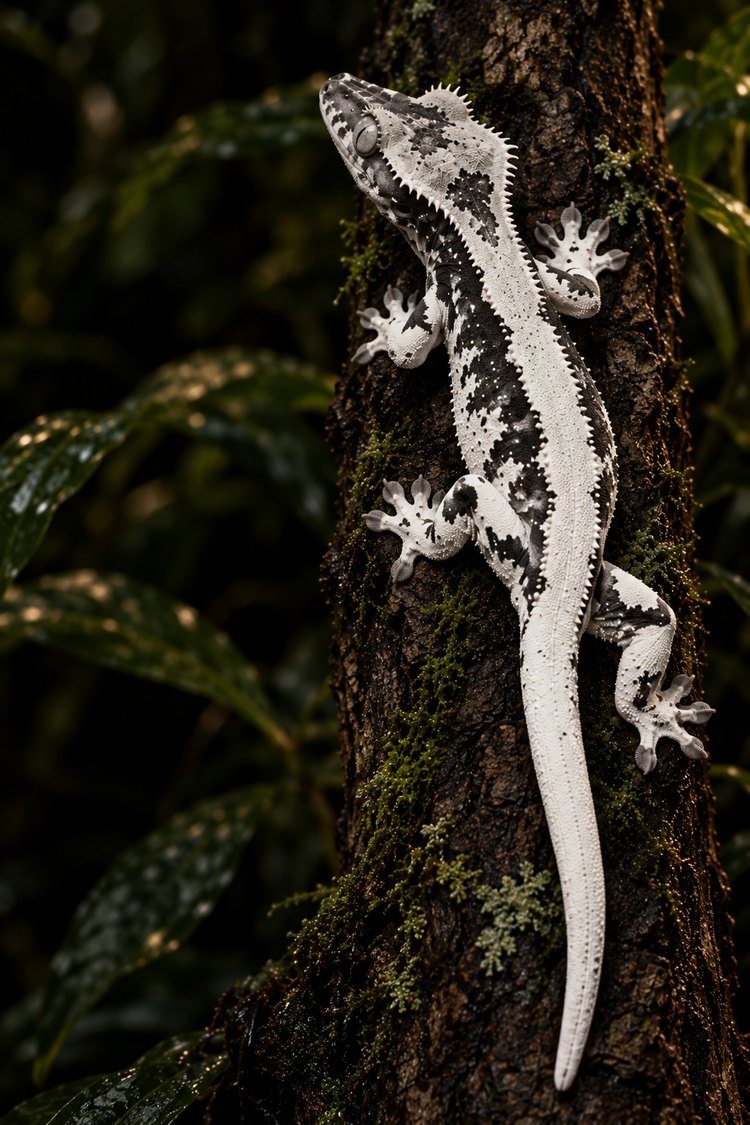
The pairing can create striking black, grey, silver and white animals. Even so, some individuals still show traces of warm color. Axanthic deserves its own article, so we will not repeat its genetics here.
Responsible Breeding
There is no single score for quality. The common mistake is judging only the percentage of white.
For a pet, health and personal appeal may be all that matters. For a breeding project, however, the evaluation should be broader. A strong Lilly White prospect combines good expression with sound structure, a full crest, healthy growth, good body condition, useful ancestry, a desirable base color or pattern, and a pedigree that suits its future partner.
A nearly white animal with poor structure or tight ancestry may be less useful than a moderate Lilly White from an excellent outcross. In other words, more white does not automatically mean better breeding.
A valuable morph name can tempt breeders to accept faults they would reject in a cheaper gecko. That is backward. A breeding Lilly White is still a crested gecko first.
Check the jaw, spine, limbs, toes, body condition, crests, head shape, movement, feeding history, growth and reproductive health. A beautiful phenotype should rest on a healthy animal, never the other way around.
Every Lilly White traces back to the original UK project. The trait has since been outcrossed widely, but pedigree management still matters.
Pairing closely related Lilly lines just because both show high coverage concentrates shared ancestry. A better strategy is often to use excellent unrelated non-Lilly partners. They bring new structure, color, pattern and genetic diversity.
The first offspring may not look as extreme as those from tight line breeding. That trade is often worth it, because a breeding program should be measured in generations, not in one clutch.
Non-Lilly offspring are surprisingly informative. They show what the pairing produces without Lilly White hiding part of the pattern.
They also keep family links visible. If a non-Lilly sibling later enters another project, accurate records prevent accidental close pairings back into related Lilly lines.
No special care has been established for an ordinary one-copy Lilly White. Give it the same excellent husbandry as any crested gecko. That includes the right enclosure size, temperatures, humidity cycles, diet, hydration, lighting, climbing space and regular health checks. Our Crested Gecko Care guide covers each of these in detail.
Claims that Lilly Whites need unusual humidity, special supplements or a different setup have not been shown. The serious established problem is the two-copy form, not the care of normal visual Lilly Whites.
If an individual gecko has a health or developmental problem, treat that animal’s condition with veterinary guidance. Do not base care on its color morph.
Long-term breeders often describe Lilly Whites as having softer, more velvety skin than other crested geckos. This may reflect differences in scale appearance or structure.
However, no published research has studied it yet. Treat it, like the icy eye color, as a repeatable breeder observation. Both can support identification, but neither should override pedigree evidence.
A good breeder should tell you much more than “this is a Lilly White”. Before buying a serious breeding animal, ask for:
Also ask whether your planned partner is related. For complex combinations, ask how each part of the label was confirmed.
If a gecko’s Lilly White status is uncertain and its parents are unknown, a high price cannot turn uncertainty into genetics. A pedigree cannot make a poor animal good. Yet, for a genetic project, missing records can make an excellent-looking animal far less useful.
Lilly White was once very scarce and expensive. That is no longer true of the morph as a whole. By 2026, many established breeders produce Lilly Whites regularly, and prices cover a wide range.
What remains scarce are certain combinations, exceptional lines, outstanding structure and highly developed expression. This is healthy progress. As the morph becomes more accessible, the focus shifts from simply owning it to what a breeder does with it.
The answer depends on what “proven” means.
Years of breeding results from many breeders support the same model. One copy produces the visual Lilly White, and two copies produce a form that does not survive. For practical breeding, this model is mature and highly repeatable.
That is a different standard. No published study has yet identified the DNA variant behind Lilly White or shown how it works. Phrases such as “the Lilly White gene reduces melanin” therefore sound more certain than the evidence allows. The trait clearly changes pigmentation, but exactly how remains an open question.
Crested gecko research now has a tool that did not exist when Lilly White appeared. In 2024, scientists published a high-quality, chromosome-level genome of Correlophus ciliatus. The 1.66-gigabase assembly places about 99.5% of the sequence on 19 chromosomes and predicts more than 21,000 protein-coding genes.
That does not mean anyone has found the Lilly White mutation. Rather, it gives researchers a reference for comparing geckos with different traits. With enough DNA samples and good pedigrees, future studies may find the variant and explain why the two-copy form fails. Until then, keep breeder evidence and molecular evidence clearly separate.
Some ideas about this morph spread faster than the evidence. Here are the most common ones.
Not true. High-white harlequins, Whitewall animals and other white-pattern lines can look remarkably similar.
Wrong. Expression and the number of copies are different things. Every ordinary Lilly White carries one copy, whether its coverage is moderate or extreme.
False. This pairing also produces an expected 25% lethal two-copy outcome, so it should be avoided.
Quite the opposite. Super Lilly White is the two-copy form, and breeder records show that it does not survive.
There is no evidence for this. One-copy Lilly Whites need excellent standard crested gecko husbandry.
Not yet. The breeding pattern is well established, but the exact mutation remains unknown.
What is a Lilly White crested gecko?
It is a crested gecko with an incomplete-dominant trait that can spread cream or white over the back, sides, belly, limbs and tail.
Who created the Lilly White morph?
Nick Lumb of Lilly Exotics in the United Kingdom established it after an unusual pale gecko hatched in late 2010.
Is Lilly White recessive?
No. Breeding results support incomplete-dominant inheritance, so one copy is always visible.
What happens if you breed a Lilly White to a normal crested gecko?
Each egg has about a 50% chance of being a Lilly White and a 50% chance of being non-Lilly.
Can you breed two Lilly Whites together?
You should not. About 25% of the eggs are expected to carry two copies, which is a lethal form.
Do Lilly Whites become whiter as they grow?
Many do. Their cream or white coverage often expands and brightens with age, although each animal differs.
How can you confirm a Lilly White?
Visual signs help, but documented Lilly White parentage is the strongest evidence until a validated DNA test exists.
Are Lilly White crested geckos still rare?
Lilly White itself is now widely available. Exceptional lines, special combinations and strong pedigrees remain less common.
The first Lilly White stood out because it looked unlike the crested geckos around it. Today, sixteen years later, simply producing a Lilly White is no longer the interesting part.
The future lies in what breeders build around it: better structure, better outcrosses, cleaner records, stronger base colors and thoughtful combinations. Eventually, science may even confirm the mutation itself.
One rule should never change. A project’s value is not measured by how unusual the offspring look. It is measured by whether we understand what we produce, and whether we produce it responsibly.
Lilly White × non-Lilly gives a project somewhere to go. Lilly White × Lilly White does not.

 Best Plants for Reptile Terrariums: Safe, Hardy Choices That Actually Work